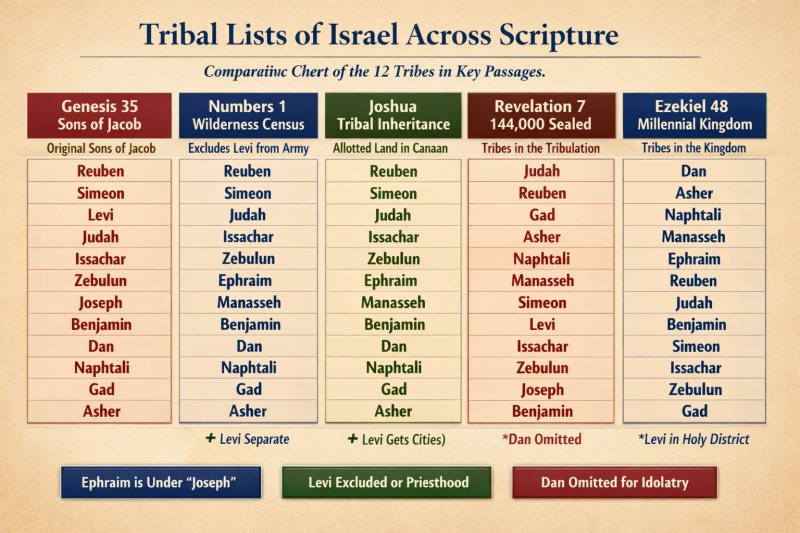
Tribes of Israel Throughout the Bible
05/09/2026
Samuel Clifford
Introduction:
One of the most fascinating parts of the Scriptures is the story of the Tribes of Israel and how they changed throughout biblical history. In this study we look at the tribes in a broad view and tracing them throughout the Bible.
Where Did The Tribes Come From?
“the sons of Leah were Reuben, Jacob’s firstborn, then Simeon, Levi, Judah, Issachar, and Zebulun; the sons of Rachel were Joseph and Benjamin; and the sons of Bilhah, Rachel’s female slave, were Dan and Naphtali; and the sons of Zilpah, Leah’s female slave, were Gad and Asher. These were the sons of Jacob who were born to him in Paddan-aram.” (Genesis 35:23-26 NASB)
The Tribes of Israel come from the sons of Jacob which I will list below:
- Reuben
- Simeon
- Levi
- Judah
- Issachar
- Zebulun
- Joseph
- Benjamin
- Dan
- Naphtali
- Gad
- Asher
However, if you read on to Numbers 1 you will realize that the names are not the same and yet are the same amount.
“These then are the names of the men who shall stand with you: of the tribe of Reuben, Elizur the son of Shedeur; of the tribe of Simeon, Shelumiel the son of Zurishaddai; of the tribe of Judah, Nahshon the son of Amminadab; of Issachar, Nethanel the son of Zuar; of Zebulun, Eliab the son of Helon; of the sons of Joseph: of Ephraim, Elishama the son of Ammihud; of Manasseh, Gamaliel the son of Pedahzur; of Benjamin, Abidan the son of Gideoni; of Dan, Ahiezer the son of Ammishaddai; of Asher, Pagiel the son of Ochran; of Gad, Eliasaph the son of Deuel; of Naphtali, Ahira the son of Enan. These are the men who were called from the congregation, the leaders of their fathers’ tribes; they were the heads of divisions of Israel.” (Numbers 1:5-16 NASB)
- Reuben
- Simeon
- Judah
- Issachar
- Zebulun
- Ephraim
- Manasseh
- Benjamin
- Dan
- Asher
- Gad
- Naphtali
Why is this and who is missing? Firstly, Joseph has been split between his two sons Ephraim and Mannaseh. This gave Joseph a double portion as Jacob intended when he adopted Joseph’s sons as his own:
“Now your [Joseph] two sons, who were born to you in the land of Egypt before I came to you in Egypt, are mine; Ephraim and Manasseh shall be mine, as Reuben and Simeon are. But your children that you have fathered after them shall be yours; they shall be called by the names of their brothers in their inheritance.” (Genesis 48:5-6 NASB)
Why did Joseph receive the double portion that is supposed to go to the first born Reuben? The Bible answers this:
“Now the sons of Reuben, the firstborn of Israel (for he was the firstborn, but because he defiled his father’s bed, his birthright was given to the sons of Joseph, the son of Israel; so he is not enrolled in the genealogy according to the birthright.” (1 Chronicles 5:1 NASB)
Reuben, Jacob’s firstborn, forfeited the birthright by sleeping with Bilhah, a concubine of Jacob (Genesis 35:22). So Joseph received the double portion which is why Ephraim and Manasseh are separate tribes. However, this should mean that there are 13 tribes, so why does Numbers 1 only list 12? Well, in actuality, it does list 13. At the end of the passage it says this of the sons of Levi:
“The Levites, however, were not counted among them by their fathers’ tribe. For the Lord had spoken to Moses, saying, ‘Only the tribe of Levi you shall not count, nor shall you take their census among the sons of Israel. And you shall appoint the Levites over the tabernacle of the testimony, and over all its furnishings and over everything that belongs to it. They shall carry the tabernacle and all its furnishings, and they shall take care of it; they shall also camp around the tabernacle. So when the tabernacle is to move on, the Levites shall take it down; and when the tabernacle encamps, the Levites shall set it up. But the layman who comes near it shall be put to death. So the sons of Israel shall camp, each man by his own camp, and each man by his own flag, according to their armies. But the Levites shall camp around the tabernacle of the testimony, so that there will be no divine wrath against the congregation of the sons of Israel. So the Levites shall be responsible for service to the tabernacle of the testimony.’ And the sons of Israel did so; in accordance with all that the Lord had commanded Moses, so they did.” (Numbers 1:47-54)
This passage explains why the tribe of Levi was excluded from Israel’s military census and given a unique religious role. While the other tribes were counted for warfare and organized by their own camps, the Levites were set apart because God assigned them to care for the tabernacle, its furnishings, and all responsibilities connected to Israel’s worship. They were to carry, assemble, and guard the tabernacle, and they camped around it as a protective buffer so that no unauthorized person would approach and incur divine judgment. Their placement ensured both the holiness of the sanctuary and the safety of the nation. In short, this passage establishes the Levites as a priestly, protective tribe, distinct from Israel’s military structure and dedicated entirely to the service of God’s dwelling among His people.
So in Numbers 1 there are technically 13 tribes:
- Reuben
- Simeon
- Judah
- Issachar
- Zebulun
- Ephraim
- Manasseh
- Benjamin
- Dan
- Asher
- Gad
- Naphtali
- Levi
Land of the Tribes:
The land allotments in Joshua mark Israel’s transition from a wandering people to a settled nation. After the major conquests, Joshua begins distributing the land according to the instructions given through Moses. The process starts with the tribes who already received territory east of the Jordan: Reuben, Gad, and the half‑tribe of Manasseh (Joshua 13). From there, the narrative moves westward, beginning with Caleb’s inheritance at Hebron (Joshua 14) and then the detailed boundaries of Judah’s large southern territory (Joshua 15). Joseph’s descendants receive the central hill country, with Ephraim’s portion described in Joshua 16 and western Manasseh’s inheritance in Joshua 17, including the notable case of Zelophehad’s daughters receiving land. Benjamin’s territory, positioned between Judah and Ephraim, is assigned next in Joshua 18, forming a politically significant buffer between the two dominant tribes.
The remaining tribes receive their inheritances in Joshua 19, where Simeon’s land is carved out of Judah’s territory, followed by the allotments for Zebulun, Issachar, Asher, Naphtali, and Dan. Dan’s portion proves insufficient, leading to its later migration northward, a development expanded in Judges 18. Finally, the tribe of Levi receives no territorial allotment, consistent with earlier instructions, but is instead assigned forty‑eight Levitical cities scattered among the tribes (Joshua 21). These allotments established the geographic and political structure of Israel for centuries, shaping everything from tribal identity to the later division between the northern and southern kingdoms.
The Tribes Unite Under a King
For most of Israel’s early history, the twelve tribes functioned as a loose confederation of independent clans bound together by covenant, worship, and shared ancestry, yet without a centralized government. This period, described in Judges, is marked by tribal fragmentation, local leadership, and repeated cycles of crisis. The turning point comes when the tribes collectively demand a king “like all the nations” (1 Samuel 8). God grants their request, and the tribes are united for the first time under a single monarch: Saul, from the tribe of Benjamin. Saul’s reign brings the tribes into a centralized political structure, though his leadership remains unstable and often contested.
The true unification of the tribes occurs under David, whom God chooses after Saul’s failure. First, the tribe of Judah anoints David as king in Hebron (2 Samuel 2). For seven years, the kingdom is divided: Judah follows David, while the northern tribes follow Ish-bosheth, Saul’s son. After Ish-bosheth’s death, the elders of all Israel come to David and declare, “We are your bone and your flesh,” uniting the tribes under one throne (2 Samuel 5). David establishes Jerusalem as the political and spiritual center of the nation, bringing the ark there and solidifying the unity of the tribes around worship and kingship.
Under Solomon, David’s son, the united kingdom reaches its peak. Solomon inherits a fully unified tribal confederation and transforms it into a wealthy, centralized empire. He builds the Temple in Jerusalem (1 Kings 6), which becomes the focal point of Israel’s religious life. The tribes remain united throughout Solomon’s reign, benefiting from peace, trade, and monumental building projects. However, Solomon’s heavy taxation and forced labor policies strain tribal loyalties, especially among the northern tribes. These tensions set the stage for the eventual division of the kingdom after Solomon’s death.
Northern and Southern Kingdom:
The primary passage describing the division of the tribes into two kingdoms is 1 Kings 12, which records how, after Solomon’s death, his son Rehoboam becomes king. When the northern tribes ask him to lighten Solomon’s heavy labor and taxation, Rehoboam refuses and threatens even harsher burdens, prompting ten tribes to break away and declare, “What portion do we have in David? … To your tents, O Israel!” They appoint Jeroboam as king over the north, forming the Northern Kingdom (Israel), while only Judah and Benjamin remain loyal to the house of David, forming the Southern Kingdom (Judah). The Levites later migrate south as well, since Jeroboam replaces the priesthood and establishes alternative worship centers.
Northern Kingdom:
- Reuben
- Simeon
- Issachar
- Zebulun
- Naphtali
- Ephraim
- Manasseh
- Dan
- Asher
- Gad
Southern Kingdom:
- Benjamin
- Judah
Oftentimes in prophetic literature, such as Hosea, the entirety of the Northern Kingdom is called “Ephraim” because of its dominance and influence in the region. Similarly, the Southern Kingdom is called “Judah” even though Benjamin is a part of it.
The Northern Kingdom, dominated by Ephraim and ruled by a succession of unstable dynasties, quickly fell into idolatry beginning with Jeroboam’s golden calves. Despite prophetic warnings from Elijah, Elisha, Hosea, and Amos, the north never returned to covenant faithfulness. Its political instability and spiritual corruption eventually led to its destruction by Assyria in 722 BC, when the northern tribes were deported and scattered, becoming what later generations called the “lost tribes.” The Southern Kingdom (Judah), centered in Jerusalem and ruled by the Davidic line, fared better spiritually but still experienced cycles of reform and rebellion. Prophets like Isaiah, Micah, Jeremiah, and Ezekiel warned Judah of coming judgment, and after centuries of wavering loyalty, Judah was conquered by Babylon in 586 BC, the temple was destroyed, and the people were exiled. Unlike the north, however, Judah eventually returned from exile under Persian rule, rebuilt the temple, and preserved the line of David, setting the stage for the later return, restoration, and the messianic hope carried into the New Testament.
Revelation 7 and The 144,000
I’ve written an article in the past on the 144,000 but the purpose of this section is to look at the tribes more specifically.
“from the tribe of Judah, twelve thousand were sealed, from the tribe of Reuben twelve thousand, from the tribe of Gad twelve thousand, from the tribe of Asher twelve thousand, from the tribe of Naphtali twelve thousand, from the tribe of Manasseh twelve thousand, from the tribe of Simeon twelve thousand, from the tribe of Levi twelve thousand, from the tribe of Issachar twelve thousand, from the tribe of Zebulun twelve thousand, from the tribe of Joseph twelve thousand, and from the tribe of Benjamin, twelve thousand were sealed.” (Revelation 7:5-8 NASB)
List of Tribes in the 144,000:
- Judah
- Reuben
- Gad
- Asher
- Naphtali
- Manasseh
- Simeon
- Levi
- Issachar
- Zebulun
- Joseph
- Benjamin
Firstly, it should be noted that Joseph has now become synonymous with Ephraim. Because Ephraim was the dominant son of Joseph, receiving the greater blessing in Genesis 48, becoming the political and spiritual center of the Northern Kingdom, and serving as the prophetic shorthand for the ten northern tribes, his tribe effectively became the primary expression of Joseph’s lineage. In Revelation 7, the list of the 144,000 includes “Joseph” instead of Ephraim, but this is understood as a way of including Ephraim under Joseph’s name while avoiding the direct naming of Ephraim, likely because of his association with idolatry in the prophets.
Secondly, Levi is instituted and Dan is left out, leaving the total number of tribes at 12. Dan is omitted from the list of the 144,000 in Revelation 7 because the tribe became strongly associated with idolatry, beginning with its unauthorized shrine and priesthood in Judges 18, and later with its role in the golden calf worship under Jeroboam in 1 Kings 12. In the prophetic books, Dan is repeatedly linked to spiritual unfaithfulness and so John intentionally avoids naming Dan to underscore this legacy of apostasy.
Millennial Kingdom Tribal Allotments:
“Now these are the names of the tribes: from the northern extremity, beside the way of Hethlon to Lebo-hamath, as far as Hazar-enan at the border of Damascus, toward the north beside Hamath, running from east to west, Dan, one portion. Beside the border of Dan, from the east side to the west side, Asher, one portion. Beside the border of Asher, from the east side to the west side, Naphtali, one portion. Beside the border of Naphtali, from the east side to the west side, Manasseh, one portion. Beside the border of Manasseh, from the east side to the west side, Ephraim, one portion. Beside the border of Ephraim, from the east side to the west side, Reuben, one portion. Beside the border of Reuben, from the east side to the west side, Judah, one portion. And beside the border of Judah, from the east side to the west side, shall be the allotment which you shall set apart, twenty-five thousand cubits in width, and in length like one of the portions, from the east side to the west side; and the sanctuary shall be in the middle of it. The allotment that you shall set apart to the Lord shall be twenty-five thousand cubits in length and ten thousand in width.” (Ezekiel 48:1-9 NASB)
“And the holy allotment and the sanctuary of the house shall be in the middle of it. And exclusive of the property of the Levites and the property of the city, which are in the middle of that which belongs to the prince, everything between the border of Judah and the border of Benjamin shall belong to the prince.” (Ezekiel 48:21-22 NASB)
“As for the rest of the tribes: from the east side to the west side, Benjamin, one portion. Beside the border of Benjamin, from the east side to the west side, Simeon, one portion. Beside the border of Simeon, from the east side to the west side, Issachar, one portion. Beside the border of Issachar, from the east side to the west side, Zebulun, one portion. Beside the border of Zebulun, from the east side to the west side, Gad, one portion. And beside the border of Gad, at the south side toward the south, the border shall be from Tamar to the waters of Meribath-kadesh, to the brook of Egypt, to the Great Sea. This is the land which you shall divide by lot to the tribes of Israel for an inheritance, and these are their several portions,” declares the Lord God.” (Ezekiel 48:23-29 NASB)
The Tribes of Ezekiel 48:
- Dan
- Asher
- Naphtali
- Manasseh
- Ephraim
- Reuben
- Judah
- Levi
- Benjamin
- Simeon
- Issachar
- Zebulun
- Gad
Ezekiel 48 describes how the land of Israel will be divided among the tribes in the future Millennial Kingdom, with each tribe receiving an equal east‑to‑west strip of territory in a perfectly ordered layout that reflects God’s justice and covenant faithfulness. The chapter begins by listing the northern tribes, Dan, Asher, Naphtali, Manasseh, Ephraim, Reuben, and Judah, followed by a central holy district containing the temple, the Levites’ land, and the prince’s territory. South of this holy portion, the remaining tribes, Benjamin, Simeon, Issachar, Zebulun, and Gad, receive their allotments. Levi is included in the chapter not as a territorial tribe but as the priestly tribe whose inheritance lies within the holy allotment rather than in a tribal strip. This entire arrangement represents Israel’s full restoration under the reign of the Messiah, with worship placed at the literal center of national life.
So why does Dan appear in Ezekiel 48 which chronologically takes place after Revelation 7? Dan appears in Ezekiel 48 even though he is omitted from the list of the 144,000 in Revelation 7 because the two passages describe different moments in God’s prophetic program. Revelation 7 concerns the sealing of faithful Israelites for service and protection during the Tribulation, and Dan’s long history of idolatry, from the carved image in Judges 18 to the golden calf worship in 1 Kings 12, makes him symbolically unsuitable for that specific list. Ezekiel 48, however, describes the Millennial Kingdom after judgment has passed and restoration has come, and in that future era God restores all twelve tribes, including Dan, even placing him first as a sign of grace and covenant faithfulness.
Overall, we see in the scriptures that the Tribes of Israel actually change throughout the Bible in that some are omitted, changed, or have different roles.