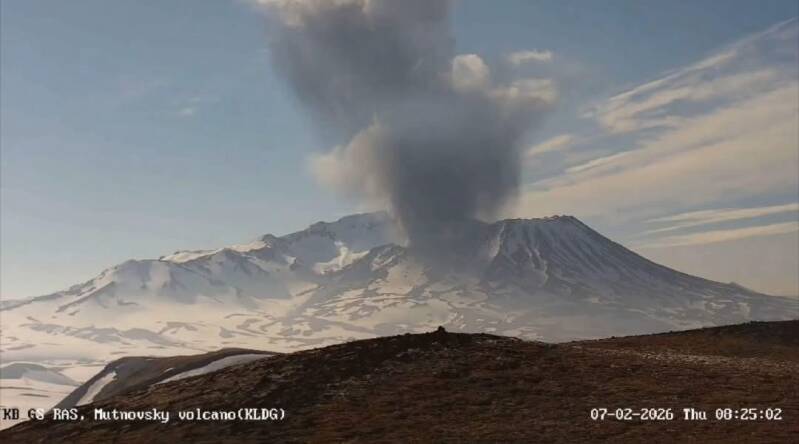
Mutnovsky Erupts For The First Time Since 2013
07/05/2026
Samuel Clifford
The Mutnovsky volcano in Russia erupted for the first time since 2013 on July 1, 2026. It produced an ash explosion at 20:19 UTC. It sent an ash plume up to around 11,500 feet above sea level and extended about 6 miles west of the volcano. The eruption lasted for about three minutes and afterward no other ash explosions were seen but continued in the form of gas and steam emissions.
Mutnovsky is a large and complex volcanic system on Russia’s Kamchatka Peninsula, built from multiple overlapping stratovolcanoes and several active craters. Its structure is dominated by broad, glacier‑covered slopes, persistent fumarolic fields (an area on a volcano where hot steam and gases constantly escape from the ground), and a long history of phreatic and hydrothermal activity rather than frequent high‑VEI eruptions. The volcano’s summit hosts several craters, most notably the Active crater, which emits continuous steam, gas, and geothermal heat. Mutnovsky is also known for its powerful geothermal fields, which feed nearby energy facilities and create striking features like boiling mud pools, sulfur vents, and ice caves formed by volcanic heat beneath snowpack. Overall, it is one of Kamchatka’s most accessible and scientifically monitored volcanoes, characterized by steady low‑level unrest and a complex internal hydrothermal system.
Mutnovsky’s activity record is often summarized differently across monitoring agencies. The Smithsonian Institution’s Global Volcanism Program currently lists June 30, 2000 as the volcano’s most recent confirmed eruption, classifying it as a tentative VEI 1 event. Yet additional scientific and regional monitoring sources note a phreatic eruption in April 2007, followed by multiple moderate phreatic explosions from the Active crater on July 3, 2013, indicating continued low‑level unrest beyond the Smithsonian’s last cataloged entry.