Spinosaurus mirabilis
02/22/2026
Samuel Clifford
Introduction
A new Spinosaurus species was announced in February 2026. Earlier in the month of February, a team of paleontologists led by Dr. Paul C. Sereno of the University of Chicago announced the discovery of an extraordinary new species of Spinosaurus uncovered in the remote Sahara Desert of Niger. Over several field expeditions, scientists unearthed numerous bones from a large, carnivorous dinosaur at a site called Jenguebi in inland fluvial deposits. After preparing and comparing these fossils in the lab, the researchers determined these remains represent a dinosaur species never before described. They formally named it Spinosaurus mirabilis and published their findings in the journal Science.

What Makes Spinosaurus mirabilis Distinct from Spinosaurus aegyptiacus?
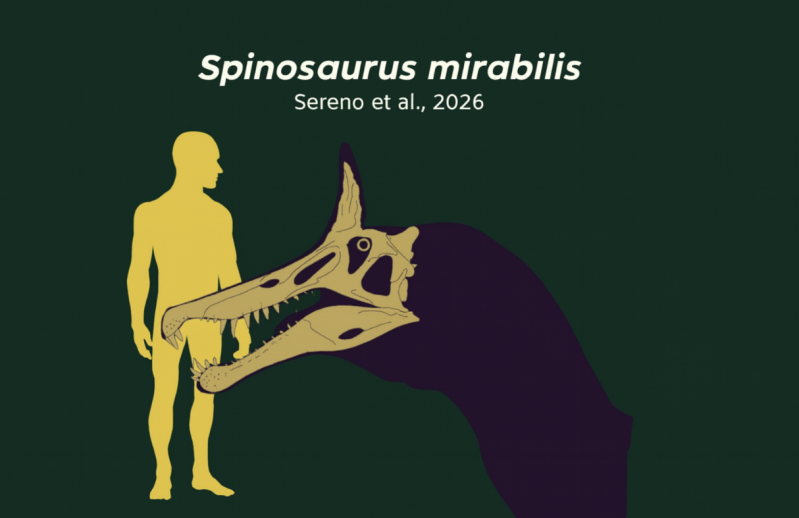
Though it belongs to the same genus as the famous Spinosaurus aegyptiacus, S. mirabilis shows several key differences. The most striking is the tall scimitar-shaped crest that rises from the top of its skull, a bone structure much more pronounced than seen in S. aegyptiacus. The snout in S. mirabilis is proportionally lower and its teeth are spaced further apart, adaptations suited to snaring fish. Its hind limbs also appear relatively longer. In combination, these features are distinct enough that scientists judge mirabilis to be a separate species, not just a variation of aegyptiacus.
Anatomy and Physiology
Spinosaurus mirabilis was a massive, heavily built theropod with a suite of specialized traits. Its long, narrow, crocodile-like snout bristled with interlocking conical teeth made for gripping slippery prey. The nostrils were positioned far back on the snout, allowing it to breathe while partly submerged in water. The most eye-catching feature was its tall cranial crest, shaped like a curved blade, likely sheathed in keratin and potentially brightly colored in life. Behind this, a large sail-like structure ran along its back, formed by elongated vertebral spines. These adaptations suggest an animal built for stalking fish and other food in shallow rivers, while also using its display structures for communication or mating displays.
Ecology: The World Spinosaurus mirabilis Lived In
The landscape S. mirabilis inhabited was nothing like the sandy desert that it was found in today. Instead, it was dissected by broad rivers winding through forested floodplains far from any ocean shoreline. In these inland freshwater ecosystems, Spinosaurus mirabilis likely hunted large fish and aquatic prey much like a giant modern heron, earning descriptors such as “hell heron” from researchers.
Although the exact mix of species at the Jenguebi site is still being studied, similar African riverine environments have yielded a rich menagerie of contemporaneous animals. In comparable fluvial deposits elsewhere in the continent, other large theropods such as carcharodontosaurids (Carcharodontosaurus) and possible abelisaurids have been found alongside spinosaurids, suggesting that Spinosaurus shared its world with other carnivorous dinosaurs. Large freshwater fish including coelacanths, sawfish, and lungfish would have been abundant, forming a major part of its diet. Crocodyliforms, turtles, pterosaurs (flying reptiles), and other reptiles likely also frequented these waterways. While evidence for herbivorous dinosaurs right at the Jenguebi site is still emerging, nearby African formations of roughly similar age have included long-necked sauropods and other land-dwelling species moving through the same ecosystem.
The closest identifiable location to the fossil site of Spinosaurus mirabilis is Tchintabaraden, in the Tahoua Region of Niger. This town lies near the Farak Formation, where the fossils were discovered. It serves as a geographic reference point for mapping the site, though the actual dig location is deeper within the desert and not adjacent to any major settlement.
Why This Is Not Just Sexual Dimorphism from S. aegyptiacus?
When paleontologists see notable differences in fossils from a known species, one possibility they consider is sexual dimorphism, differences between males and females of the same species. However, in the case of Spinosaurus mirabilis, the collection of traits that distinguish it from S. aegyptiacus. Traits such as the shape and size of its skull crest to its snout proportions and tooth spacing are too consistent and functionally significant to be explained by sex differences alone. Instead, these traits appear to represent evolutionary adaptations to a particular ecological niche, supporting the conclusion that S. mirabilis is a distinct species within the genus.
Conclusion
The identification of Spinosaurus mirabilis paints a more complex picture of spinosaurid diversity than previously appreciated. With its scimitar-shaped crest, specialized fish-catching anatomy, and adaptations for life in riverine environments, this “astonishing Spinosaurus” reveals new dimensions to how these giant predators lived and interacted with other animals in their ecosystems. Rather than simply a variant of S. aegyptiacus, S. mirabilis stands as a distinct species with its own story to tell, deepening our understanding of prehistoric life in ancient Africa.

The Institute for Creation Research argues that the newly described species Spinosaurus mirabilis supports a young‑earth, global‑Flood interpretation of the fossil record. It claims that conventional paleontology incorrectly assumes fossils are buried where the animals lived, whereas a biblical worldview interprets most fossils as the result of rapid, catastrophic burial during Noah’s Flood. The author highlights several details from the Spinosaurus discovery such as fragmentary remains, burial alongside inland sauropods, and the site’s distance from ancient shorelines as evidence of large‑scale water transport rather than slow, local sedimentation. The article concludes that mixed fossil assemblages and widespread sedimentary deposits align more naturally with a global Flood model than with standard geological explanations.
Sources
Sereno, Paul C., et al. “New scimitar-crested Spinosaurus species from the Sahara caps stepwise spinosaurid radiation.” Science, 19 Feb. 2026, science.org/action/downloadSupplement?doi=10.1126%2Fscience.adx5486&file=science.adx5486_sm.pdf.
“‘A Horned ‘Hell Heron’ Fossil Found in Sahara Upends What Was Known …’” The Independent, 2026, www.the-independent.com/news/science/spinosaurus-fossil-sahara-dinosaur-movement-b2924079.html
Haynes, Gabriela. “New Species of Spinosaurus Supports Flood Catastrophe.” Institute for Creation Research, 16 Mar. 2026, www.icr.org/article/new-species-spinosaurus-supports-flood