Foraminifera and Rapid Diversification
1/22/2026
Samuel Clifford
Foraminifera and Rapid Diversification
A recent publication from Christopher M. Lowery, Timothy J. Bralower, Kenneth Farley, and R. Mark Leckie provides insight into the biological aftermath of the proposed K-PG extinction event from a uniformitarian view. However, this article also sheds light on rapid diversification in a post flood world as will be discussed here.
What are Foraminifera?
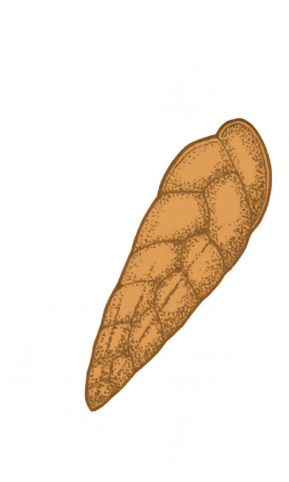
Foraminifera are microscopic, single‑celled protists that live in marine and brackish environments. Although each organism is only a single cell, it builds a remarkably intricate external shell called a test using minerals from seawater. These tests accumulate in ocean sediments and in areas where seawater once covered the continents, making foraminifera one of the most abundant and informative groups of microfossils used in studying past environments.
Their tests display an impressive range of materials and designs. Many species construct shells of calcite or aragonite, which may appear milky, grey, or glassy depending on the crystal structure. Others produce flexible organic tests, while agglutinated forms cement together grains of sand, silt, or fragments of other microorganisms. Test architecture can be simple, such as tubular forms or bead‑like chains, or more elaborate, including planispiral, trochospiral, and other complex chamber arrangements. The first chamber, the proloculus, varies in size depending on whether the organism originated from sexual or asexual reproduction.
Inside the test, the living cell consists of soft protoplasm that extends outward through one or more apertures to form long, thread‑like pseudopodia. These filaments allow the foram to move, anchor itself, and capture food such as algae, diatoms, bacteria, and organic detritus. Within the shell, the protoplasm houses the nucleus and carries out digestion. This combination of simple cellular structure and sophisticated shell‑building has allowed foraminifera to thrive in nearly every marine setting, making them a key group for understanding ocean life and sedimentary environments.
New Publication
The study presents a major revision to the timeline of biological recovery after the proposed Chicxulub impact by using a high‑precision Helium‑3 dating method to track the earliest stages of post‑extinction evolution. Unlike traditional approaches that rely on sedimentation rates, often distorted by the chaos following a mass extinction, this technique provides a far more stable and accurate chronological framework. With this improved resolution, the researchers discovered that key post‑impact plankton species such as Parvularugoglobigerina eugubina appeared between 3,500 and 11,000 years, according to uniformitarian views, after the supposed asteroid strike that caused this extinction event, and in some locations entirely new foraminifera species emerged in under 2,000 years. This represents the fastest evolutionary rebound ever documented in the fossil record, with 10 to 20 new species arising within just 6,000 years according to uniformitarian views.
Beyond refining the timeline, the publication highlights the extraordinary resilience and adaptability of life in the aftermath of global catastrophe. The near‑total collapse of marine and terrestrial ecosystems created ecological vacancies that surviving organisms rapidly exploited, turning the disrupted ocean surface into a hotspot of evolutionary innovation. Early‑diversifying plankton played a foundational role in rebuilding marine food webs, initiating a recovery that would continue for millions of years according to uniformitarian views. The authors emphasize that this rapid rebound underscores both the dynamism of evolution and the potential for ecosystems to recover when environmental conditions stabilize, an insight that carries meaningful implications for understanding modern biodiversity crises driven by human activity.
Implications for Young Earth Creationism
The majority of Young Earth Creationists hold to a flood model. The boundary for the beginning and end of the flood model may vary. Yet, most models whether it is a K/PG flood model or Lower Cenozoic Flood model expect rapid diversification after the catastrophic flood. The study finds new species appearing in under 2,000 years, 10–20 species diversifying in 6,000 years, and major ecological restructuring in a few thousand years. From a mainstream evolutionary standpoint, this is shockingly fast. But from a YEC perspective, rapid diversification after a global catastrophe is exactly what many creationist models propose and actually at an even faster rate.
The Helium-3 Method of dating assumes cosmic dust flux is roughly constant over long times and that sediment layers represent long periods of slow accumulation. If cosmic dust didn’t fall at a constant rate, then the Helium‑3 “clock” would run too fast or too slow, making sediment layers appear much older or younger than they really are. If sedimentation happened rapidly or catastrophically, the added material would dilute Helium‑3 concentrations, causing the method to underestimate the true amount of time represented. Because the age calculation depends directly on both the dust‑flux rate and the sedimentation rate, any change in either one alters the final age dramatically. In catastrophic conditions, like those proposed in YEC models, the method no longer measures real time but instead reflects shifting environmental processes.
From a young‑Earth creationist perspective, the Chicxulub foraminifera study is useful for illustrating how quickly organisms can diversify after a global catastrophe, but its timeline cannot be accepted as written because it relies on Helium‑3 dating assumptions that don’t hold under catastrophic conditions. The biological evidence of new species appearing rapidly, ecosystems rebuilding quickly, and diversification happening in tight bursts fits well within YEC expectations for post‑Flood speciation. However, the absolute ages in the study depend on the ideas that cosmic dust falls at a constant rate and that sediments accumulate slowly over long periods, both of which YEC models reject because a global Flood would disrupt dust flux and produce rapid, high‑energy sedimentation. For that reason, a YEC interpretation embraces the pattern of rapid diversification but views the thousands‑of‑years dates as inflated products of old‑Earth assumptions rather than actual elapsed time.
From a YEC perspective, the dates in the article may be wrong, but the pattern of diversification is still meaningful because the pattern does not depend on the Helium‑3 timeline. What the researchers actually observed in the rock record is a sudden appearance of many new foraminifera species in a very thin sequence of sediment, with no long, gradual buildup between forms. That physical pattern indicates rapid biological change, regardless of how many years the authors assign to that interval. After the flood, the effect of less competition and fewer filled niches would have fueled rapid diversification and this study confirms such a view.
Conclusion
The findings of this new foraminifera study offer a striking example of rapid biological change following a global catastrophe which is an observation that aligns far more naturally with young‑Earth creationist expectations than with traditional uniformitarian timescales. While the authors interpret their results through a Helium‑3 dating framework that assumes slow, stable processes over millions of years, the physical evidence in the rock record tells a different story: a sudden, concentrated burst of diversification preserved within a thin package of sediment. Such a pattern is exactly what YEC flood models predict as ecosystems reorganize, niches reopen, and surviving organisms rapidly adapt to dramatically altered environments. Although the absolute ages assigned by the study rest on assumptions incompatible with catastrophic geology, the biological signal itself of swift diversification, rapid ecological restructuring, and the near‑instant appearance of multiple new species strongly supports the plausibility of accelerated post‑Flood speciation. In this way, the research unintentionally reinforces a central YEC claim: that significant evolutionary change can occur quickly when the world is recovering from profound upheaval.
Sources
Foraminifera. Smithsonian Ocean, Smithsonian Institution, https://ocean.si.edu/ocean-life/plankton/foraminifera
Lowery, Christopher M., et al. “New Species Evolved within a Few Thousand Years of the Chicxulub Impact.” Geology, Geological Society of America, 2026, https://pubs.geoscienceworld.org/gsa/geology/article-abstract/doi/10.1130/G53313.1/724558/New-species-evolved-within-a-few-thousand-years-of?redirectedFrom=fulltext&fbclid=IwVERFWAPfGCpleHRuA2FlbQIxMQBzcnRjBmFwcF9pZAo2NjI4NTY4Mzc5AAEev2YoSFhe0rBkBGTupUUxId2O3B7HhCQDsMyIWWTzEeYNqwUPZcbWGiaA73U_aem_NZ4lfAg15pp3nyhKD2pWBg