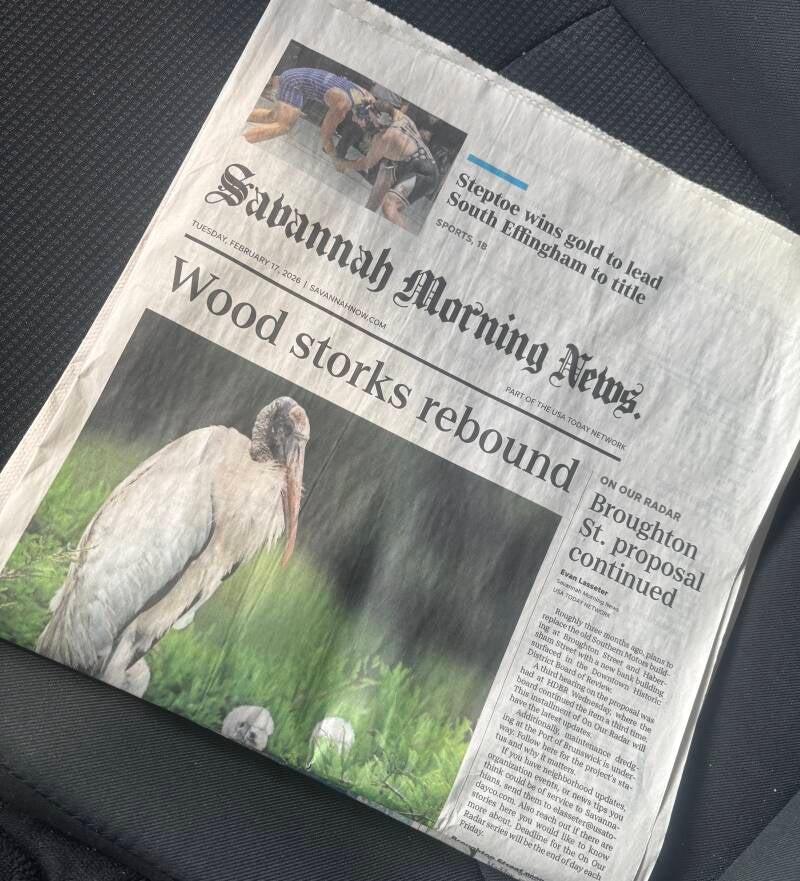
The Rise, Decline, and Recovery of the Wood Stork
02/18/2026
Samuel Clifford
Wood Storks (Mycteria americana) are the only stork species native to the United States and are often seen as a symbol of the Southeastern wetlands. They feed by wading through shallow water and snapping up fish with their bills, a method that only works when water levels are just right. Their nesting habits also depend on these conditions. Wood Storks build large colonies in swamps or mangrove islands and need the dry season to lower water levels so fish gather in small pools. If water rises too high or drains too quickly, adults cannot find enough food, and entire colonies may abandon their nests. Because their survival is tied so closely to wetland conditions, Wood Storks are an important indicator of the health of the entire ecosystem (U.S. Fish and Wildlife Service, Species Profile).
In the 1930s, Wood Storks reached their historical peak in population, with an estimated 60,000 to 100,000 breeding pairs across the southeastern United States. The majority of these colonies were located in South Florida, especially in the Everglades, where natural wet and dry seasons created ideal feeding conditions for raising chicks (Ogden 599). This stability began to change in the 1940s as massive federal and state water‑control projects reshaped the Everglades. Wetlands were drained for agriculture, flood control, and expanding cities, and new canals and levees disrupted the natural timing of seasonal flooding. These changes prevented fish from concentrating in shallow pools during the dry season, which meant adult storks could no longer reliably feed their young. By the 1960s, nesting failures had become common throughout South Florida (Light and Dineen 47; Kushlan et al. 12).

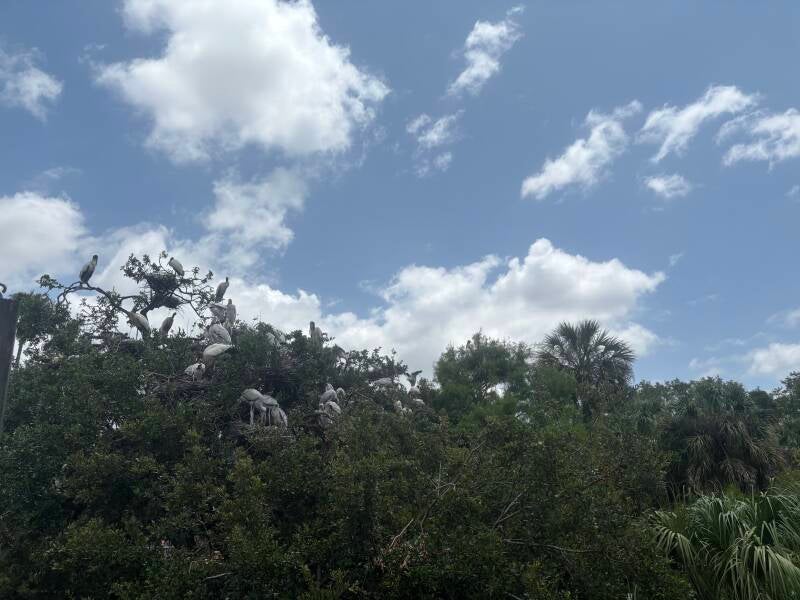
Image Above: Wood Storks Nesting in Trees at Jacksonville Zoo in Jacksonville Florida. They are not captive but instead are wild and choose to nest on the trees in the zoo.
During the 1970s, the Wood Stork population had totally collapsed. The number of breeding pairs in the United States decreased to between 5,000 and 10,000, a decline of more than 80 percent from the 1930s (Ogden 600). Several varying factors contributed to this dramatic drop, including widespread wetland drainage, altered water timing caused by human engineering, increased nest disturbance, and exposure to environmental contaminants such as pesticides (Kushlan et al. 18). The situation became so severe that in 1984 the U.S. Fish & Wildlife Service listed the Wood Stork as endangered, citing habitat loss and sharply reduced nesting success as primary causes (U.S. Fish and Wildlife Service, Species Profile).
Various recovery efforts began in the 1990s and continued through the 2010s. These efforts included major Everglades restoration projects, new protections for nesting colonies, reforms in water‑management practices, and the creation of artificial wetlands and managed impoundments that provided more reliable feeding areas. As a result, Wood Storks expanded their nesting range northward into Georgia and the Carolinas, where water conditions were more stable and predictable (National Audubon Society). Over time, these conservation measures helped stabilize the population and improve breeding success.
By 2023, the U.S. Fish & Wildlife Service announced that the Wood Stork had recovered enough to be removed from the endangered species list. The population had rebounded significantly, and nesting colonies were thriving in multiple states (U.S. Fish and Wildlife Service, Species Profile). On February 9, 2026, the species was formally removed from the federal list of endangered and threatened wildlife (U.S. Fish and Wildlife Service, Federal Register). Even with this success, environmental groups cautioned that the species’ recovery remains fragile. Ongoing threats such as climate‑driven changes in rainfall, sea‑level rise, and renewed pressure on wetland protections could once again disrupt the delicate hydrological patterns Wood Storks depend on.
Sources:
Kushlan, James A., et al. The Impacts of Hydrologic Change on the Wood Stork. U.S. National Park Service, Everglades National Park, 1979.
Light, Stephen S., and J. Walter Dineen. “Water Control in the Everglades: A Historical Perspective.” Everglades: The Ecosystem and Its Restoration, edited by Steven M. Davis and John C. Ogden, St. Lucie Press, 1994.
National Audubon Society. “Wood Stork.” Audubon Guide to North American Birds, 2024.
Ogden, John C. “Status and Biology of the Wood Stork in the United States.” The Wilson Bulletin, vol. 100, no. 4, 1988, pp. 599–620.
U.S. Fish and Wildlife Service. Wood Stork (Mycteria americana) Species Profile. U.S. Department of the Interior, 2023.
U.S. Fish and Wildlife Service. “Endangered and Threatened Wildlife and Plants; Removal of the Wood Stork from the Federal List of Endangered and Threatened Wildlife.” Federal Register, 9 Feb. 2026.