Malacosoma disstria (Forest Tent Caterpillar Moth)
04/05/2026
Samuel Clifford
Classification:
Kingdom: Animalia
Phylum: Arthropoda
Class: Insecta
Order: Lepidoptera
Family: Lasiocampidae
Genus: Malacosoma
Species: disstria

Larvae

Adult

I encountered this species in its larvae stage multiple times in the first week of April 2026 in Beaufort, South Carolina and later in Savannah, Georgia. I distinguished it from the Eastern Tent Caterpillar (Malacosoma americanum) by the dorsal pattern: M. disstria has a row of white keyhole‑shaped spots, whereas M. americanum has a solid white dorsal stripe.
Unlike other Malacosoma species, the larvae of M. disstria do not construct tents. Instead, they create silk mats on trunks and large branches where groups rest or molt, and they lay silk trails along their travel routes. I likely observed this when a wandering larva deposited silk strands in a building crevice (image to the left).
The caterpillars are generally harmless but may cause mild allergic reactions in sensitive individuals. They can defoliate hardwood trees, and while most defoliation is temporary, populations occasionally reach outbreak levels that cause extensive but usually non‑fatal defoliation.
This species is found throughout most of the continental United States and southern Canada. Its distribution is broad and not limited to the East; it occurs across the continent wherever suitable host trees are present.
Life Cycle:
- Eggs are laid in dark, glossy bands encircling small twigs and coated with spumaline. These overwinter and hatch in early spring.
- Larvae feed gregariously at first and molt through five instars, developing the characteristic keyhole‑shaped dorsal spots. Older larvae disperse in search of food or pupation sites.
- Pupation occurs in pale yellow cocoons placed in leaves, bark crevices, or sheltered structures. The pupal stage lasts about 10 days.
- Adults are short‑lived (5–10 days), do not feed, and are active in the late afternoon and at night. Their wingspan ranges from 25–37

A comparison of Forest Tent (left) and Eastern Tent (right)
Caterpillars in Prince George's Co., Maryland (4/19/2012).
Sources:
Schowalter, Timothy D. “Biology and Management of the Forest Tent Caterpillar (Lepidoptera: Lasiocampidae).” Journal of Integrated Pest Management, vol. 8, no. 1, 2017, p. 24. Oxford Academic, https://doi.org/10.1093/jipm/pmx022.
Home & Garden Information Center. Forest Tent Caterpillar. Clemson University Cooperative Extension, 5 Dec. 2024
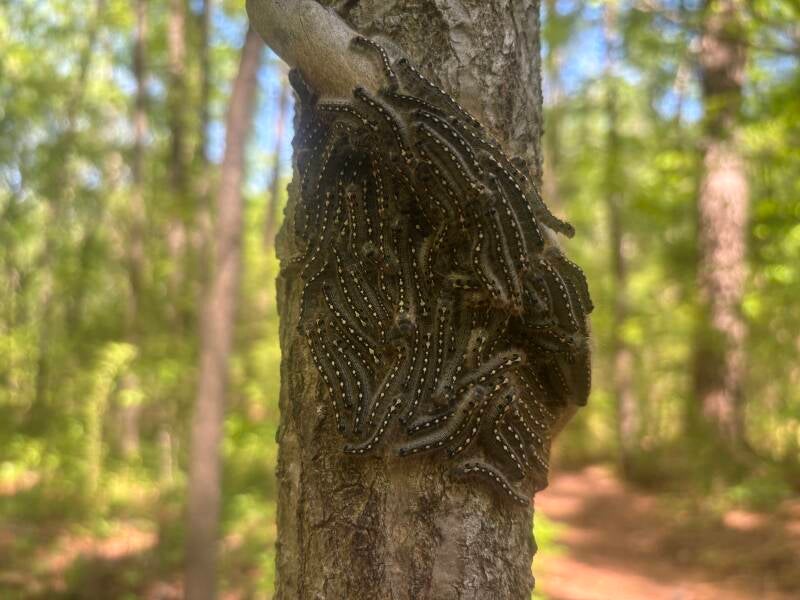
Image of a multitude of young larvae taken in Zebulon, GA