U.S.-Israel Joint Attack On Iran (Feb. 2026)
02/28/2026
Samuel Clifford
Introduction
The tensions between the United States and Iran has heightened even more in the past year although the history between the two nations has always been filled with a large amount of tension. It’s been a feature of Middle Eastern geopolitics since the 1979 hostage crisis, when Iranian revolutionaries seized the U.S. Embassy in Tehran and held 52 Americans for 444 days. That rupture hardened into decades of hostility shaped by Iran’s support for regional proxy groups such as Hezbollah in Lebanon, Hamas in Gaza, and the Houthis in Yemen, as well as by attacks on U.S. forces and partners attributed to Iranian‑backed militias. These actions reinforced Washington’s view of Iran as a destabilizing actor, while Tehran framed U.S. sanctions, military presence, and alliances as threats to its sovereignty.
Operation Midnight Hammer
By early 2026, U.S.–Iran relations had deteriorated to their lowest point in years, shaped heavily by the aftermath of Operation Midnight Hammer, the U.S. air campaign conducted in 2025 against Iranian nuclear facilities. That operation, carried out with B‑2 bombers, targeted multiple enrichment and weapons‑development sites deep inside Iran. Tehran accelerated covert enrichment efforts, expanded missile production, and intensified coordination with proxy militias across the region. In Washington, the administration increasingly framed Iran as a regime racing toward nuclear breakout while simultaneously destabilizing the Middle East.
Iranian Protests
Iran was convulsed by massive nationwide protests beginning in January 2026, triggered by economic collapse, corruption, and anger at the regime’s violent suppression of dissent. Demonstrations spread across major cities, including Tehran, Shiraz, Mashhad, and Isfahan, with students, workers, and women’s groups forming the backbone of the movement. Security forces responded with mass arrests, live fire, and internet blackouts, drawing international condemnation. The Trump administration publicly backed the protesters, citing the crackdown as evidence that the regime was losing legitimacy and warning that Iran’s internal instability made its nuclear ambitions even more dangerous.
Operation Epic Fury
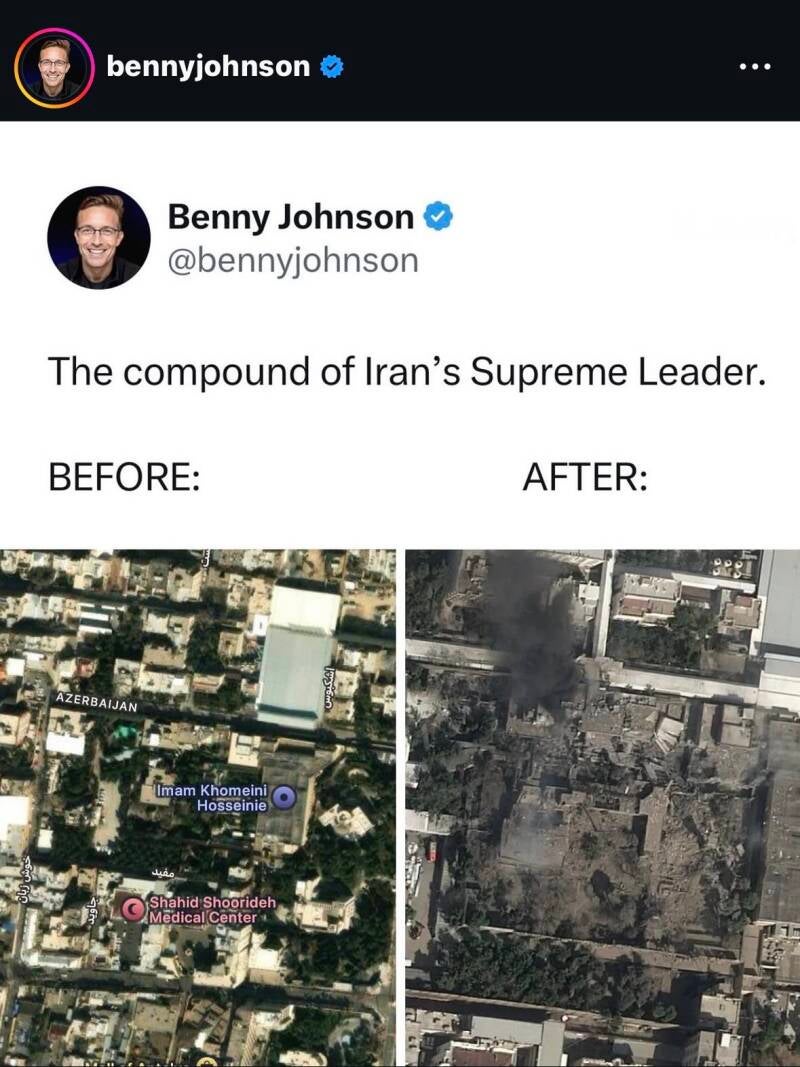
The United States and Israel launched a coordinated assault on Iran early Saturday (February 28, 2026) under the operational name Operation Epic Fury, with Israel simultaneously conducting its own strikes under Operation Roaring Lion. U.S. forces targeted Iran’s ballistic‑missile and nuclear infrastructure, while Israel struck political and military leadership sites, including areas near the office complex of Supreme Leader Ayatollah Ali Khamenei in central Tehran. Explosions were reported across Tehran, Tabriz, Qom, and other cities. Iranian retaliation followed quickly, with missiles fired at U.S. bases in Bahrain, Qatar, Kuwait, the UAE, and Jordan, as well as at Israel. Although Iranian media claims that 50 U.S. service members have been killed, U.S. Central Command states there are no reported U.S. casualties. The Iranian media also claims a U.S. navy ship has been struck by missles which is also not confirmed.
Reaction
Foreign governments reacted with alarm as the scale of the strikes became clear. Israel framed its actions as a necessary pre‑emptive measure to degrade imminent threats, while Gulf states reported incoming Iranian fire as part of Tehran’s retaliation. Domestic reactions in the United States focused primarily on national security and the protection of U.S. personnel rather than partisan confrontation, with leaders emphasizing the seriousness of the moment and the need to prevent a broader regional war. Reporting so far highlights concern about escalation rather than partisan commentary, reflecting the gravity of the situation and the uncertainty surrounding Iran’s next steps.
Retaliatory Response of Iran
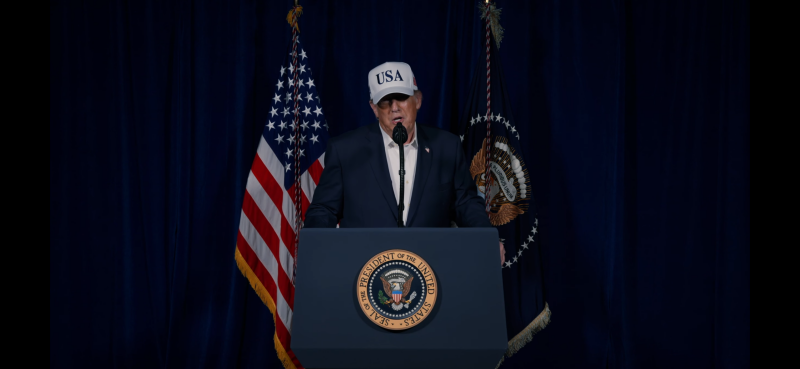
Speaking from Mar‑a‑Lago, President Trump announced that the United States had begun “major combat operations” in Iran, describing the Iranian government as a “wicked” and “radical dictatorship” and urging Iranian officials to lay down their arms. He called on the Iranian people to “take over your government,” framing the strikes as a defensive action intended to prevent threats to American national security. With Iran already launching retaliatory attacks and both U.S. and Israeli officials signaling readiness for sustained operations, the conflict appears poised to enter a volatile and unpredictable phase. Analysts warn that the duration and scope of the confrontation will depend heavily on Iran’s next moves and the ability of regional actors to contain further escalation.
Iran responded to the U.S.–Israel strikes with a region‑wide, multi‑axis counteroffensive, launching missiles, drones, and cruise weapons at American and Israeli positions across the Middle East. Iranian state media announced that its forces had struck a U.S. naval installation in Bahrain, a critical hub for the U.S. Fifth Fleet, with explosions reported near the base as air‑raid sirens sounded across Manama. Tehran simultaneously initiated drone and missile barrages against U.S. military sites in Qatar, the United Arab Emirates, and Bahrain, attempting to overwhelm layered air defenses in what analysts described as Iran’s broadest retaliatory strike in years. Additional salvos targeted Israel directly, with explosions heard in Jerusalem and air‑defense batteries engaging incoming projectiles over northern and central Israel. The scale of the retaliation extended beyond direct U.S. and Israeli targets: Iran also struck Gulf states hosting American forces, prompting defensive responses from multiple allied militaries and forcing rapid adjustments to regional security postures. Satellite imagery later confirmed damage at the Konarak Naval Base in southern Iran, part of the broader exchange of strikes, showing vessels burning at the pier following U.S.–Israel attacks and Iran’s subsequent counterfire. The combined effect of these retaliatory operations demonstrated Iran’s intent to signal that any attack on its territory would trigger a theater‑wide response, not a limited or symbolic one, and that U.S. partners across the Gulf would be drawn into the conflict whether they wished to be or not.
Economic Consequences
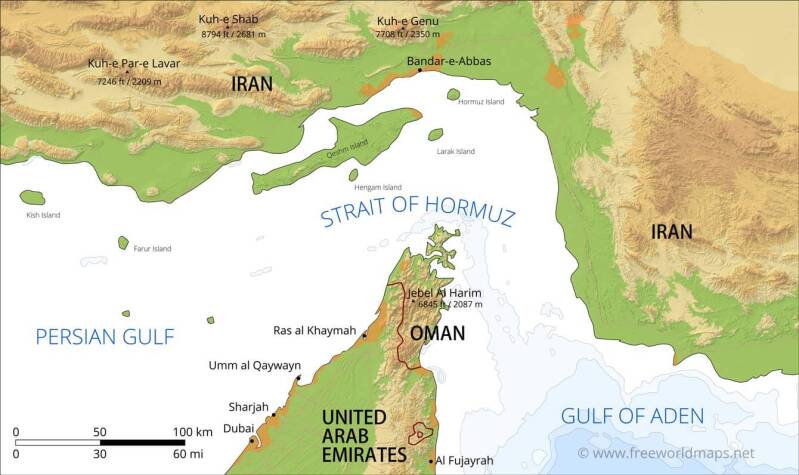
Early trading showed U.S. equity futures falling, reflecting investor flight from risk assets as geopolitical uncertainty surged. Analysts warned that the conflict could have “far greater market consequences” than recent geopolitical flare‑ups, with fears centered on the Strait of Hormuz, the chokepoint through which roughly a fifth of the world’s oil supply moves. Oil prices jumped as some major energy traders suspended crude and fuel shipments through the region, while safe‑haven assets such as gold and the U.S. dollar strengthened, consistent with historical patterns during Middle Eastern crises. Market watchers noted that investors were bracing for turbulence across the S&P 500, Dow Jones, and Nasdaq, with defense stocks likely to rise while broader equities faced downward pressure.
Iran's Leader Deceased
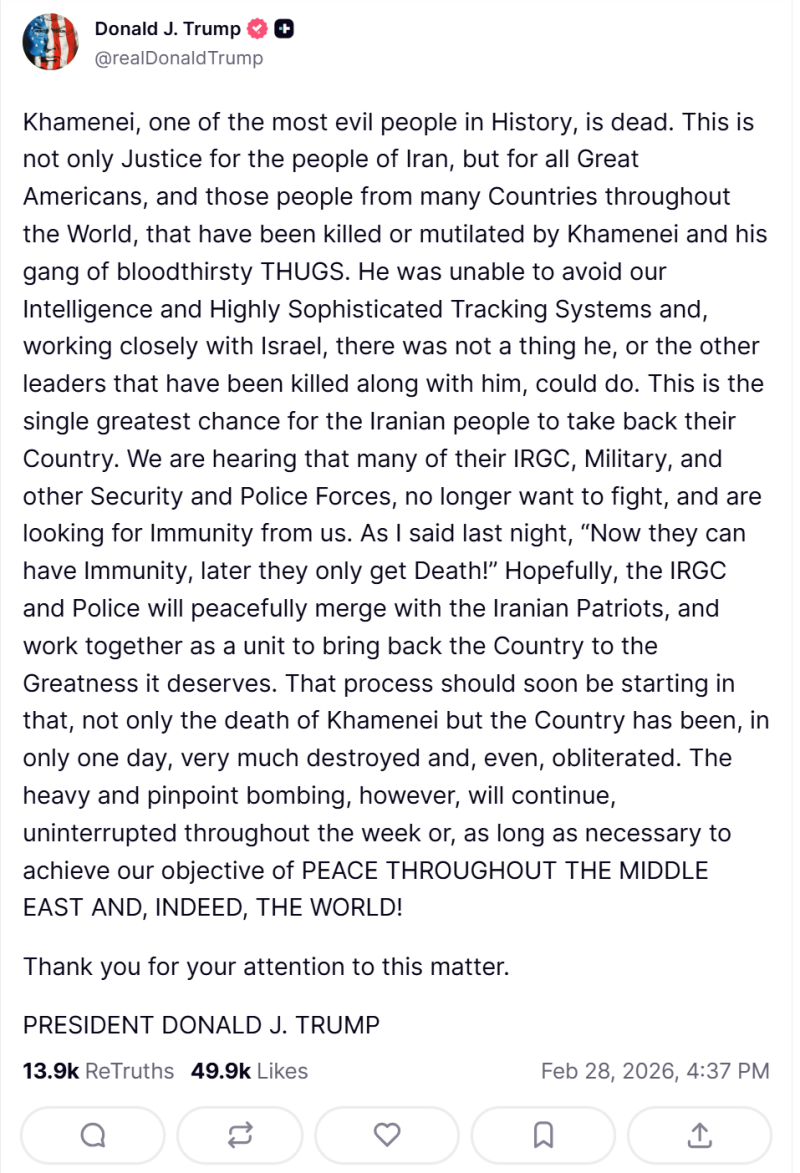
Iran’s Supreme Leader Ayatollah Ali Khamenei has now been confirmed dead following the U.S.–Israel strikes, according to multiple senior Israeli officials and U.S. intelligence sources. Reports indicate that Khamenei was killed inside or near his Tehran leadership compound during Operation Epic Fury, the coordinated offensive targeting Iran’s top political and military command. Israeli Prime Minister Benjamin Netanyahu stated there were “more and more signs” that Khamenei had been eliminated, while a senior American intelligence official told CBS News that he is dead. Crowds in Tehran were reported cheering in the streets as news spread, though Iranian state media has not issued formal confirmation. Khamenei, 86, had ruled Iran since 1989 and exercised absolute authority over the military, judiciary, and security apparatus; his death leaves the regime in a moment of profound uncertainty, with much of Iran’s senior leadership also reported killed in the strikes.
Images and Videos of Today:
Sources
CBS News. “Iran’s Supreme Leader Ayatollah Ali Khamenei Killed in Strikes, Led Theocratic Regime for Decades.” CBS News, 28 Feb. 2026.
Defense News. Gambrell, Jon, et al. “Iran Supreme Leader Ayatollah Ali Khamenei Is Dead, White House Confirms.” Defense News, 28 Feb. 2026.
Fox News. Lachter, Efrat, et al. “Supreme Leader of Iran Khamenei Dead Following Israel’s Strike on Iran.” Fox News, 1 Mar. 2026.
KXAN Austin. “Trump Says Iran Supreme Leader Ayatollah Ali Khamenei Is Dead, Israel Confirms.” KXAN, 28 Feb. 2026.
NBC News. “Live Updates: Trump Says Iran Supreme Leader Ali Khamenei Is Dead After U.S., Israel Attack.” NBC News, 28 Feb. 2026.
NewsNation. Soriano, Ashley N., et al. “US, Israel Strike Iran, Khamenei Confirmed Dead.” NewsNation, 28 Feb. 2026.
The Independent. Trew, Bel, et al. “Iran Latest: Trump Confirms Supreme Leader Ayatollah Khamenei Killed in US‑Israeli Strikes.” The Independent, 1 Mar. 2026.
USA Today. “Iran Leader Khamenei Is Dead. Maps, Satellite Images Show US Attack.” USA Today, 28 Feb. 2026.
Update March 5, 2026:
In the days following the strikes, Iran entered a period of political uncertainty as the government moved quickly to stabilize the regime after the confirmed death of Supreme Leader Ayatollah Ali Khamenei. Iranian state media officially confirmed his death on March 1, 2026, announcing a national mourning period of forty days and declaring several public holidays across the country. Khamenei, who had ruled Iran since 1989, exercised enormous authority over the country’s military, judiciary, and intelligence apparatus, making his sudden removal one of the most significant political shocks in the history of the Islamic Republic. Reports also indicated that several members of his family and close political associates were killed during the strikes on leadership compounds in Tehran.
With the supreme leadership position vacant, Iran’s political system began the process of selecting a successor through the Assembly of Experts, the clerical body responsible for appointing the country’s supreme leader. In the interim, Iranian authorities formed a temporary leadership structure to maintain control of state institutions and the military while succession deliberations continued. However, officials publicly denied widespread speculation about specific candidates, emphasizing that no final decision had yet been made. The uncertainty surrounding Iran’s future leadership raised concerns among analysts that internal political struggles could emerge within the regime’s clerical and military factions.
Within hours of Operation Epic Fury, the Islamic Revolutionary Guard Corps (IRGC) fired ballistic missiles and large waves of drones toward U.S. military installations and allied facilities across the Middle East. Targets included Al Udeid Air Base in Qatar, Al-Dhafra Air Base in the United Arab Emirates, Ali Al-Salem Air Base in Kuwait, and the U.S. Fifth Fleet headquarters in Bahrain. Iranian missiles also struck Muwaffaq al-Salti Air Base in Jordan, where U.S. forces are stationed. U.S. Central Command reported that many of the projectiles were intercepted by American and allied air defense systems, but some infrastructure damage occurred, including reported runway damage at the Kuwaiti airbase and damage to facilities near the Al Udeid base in Qatar.
Iran also expanded its attacks beyond direct military targets. Missiles and drones crossed the airspace of several Gulf states, including Saudi Arabia, Oman, and the United Arab Emirates, while some projectiles impacted urban areas after interception debris fell. By early March, the United Arab Emirates reported hundreds of Iranian drones and ballistic missiles targeting the country, resulting in multiple civilian injuries and several deaths caused by falling debris from intercepted projectiles. In response, Gulf states closed portions of their airspace, activated air-defense networks, and began coordinating closely with U.S. forces to intercept incoming missiles.
The conflict rapidly expanded beyond the immediate U.S.–Iran confrontation as regional actors and Iranian-aligned proxy groups entered the fighting. Hezbollah in Lebanon began launching rockets and drone strikes toward northern Israel in early March following confirmation of the death of Iran’s Supreme Leader. Israeli forces responded with airstrikes on Hezbollah infrastructure in Beirut and southern Lebanon, dramatically escalating the long-running Israel–Hezbollah conflict and drawing Lebanon directly into the broader regional war.
Atlantic Council. “Experts React: The U.S. and Israel Just Unleashed a Major Attack on Iran. What’s Next?” Atlantic Council, 28 Feb. 2026.
https://www.atlanticcouncil.org/dispatches/experts-react-the-us-and-israel-just-unleashed-a-major-attack-on-iran-whats-next/
CBS News. “Trump Says Iran Operation Could Take ‘Four Weeks or Less’ as U.S.–Israel Strikes Continue.” CBS News, 3 Mar. 2026.
https://www.cbsnews.com/live-updates/us-iran-war-israel-supreme-leader-khamenei-funeral-day-2/
Center for Strategic and International Studies. “Iran’s Missile Capabilities and Regional Strike Strategy.” CSIS, 2025.
https://www.csis.org/analysis/irans-missile-capabilities-and-regional-strike-strategy
Critical Threats Project. “Iran Update: Evening Special Report, February 28, 2026.” American Enterprise Institute, 28 Feb. 2026.
https://www.criticalthreats.org/analysis/iran-update-evening-special-report-february-28-2026
PBS NewsHour. “Live Updates: U.S. and Israel Attack Iran and Tehran Retaliates Across the Region.” PBS NewsHour, 1 Mar. 2026.
https://www.pbs.org/newshour/world/live-updates-u-s-and-israel-attack-iran
TIME. “Iran Warns United States Will ‘Bitterly Regret’ Sinking Iranian Warship as Conflict Escalates.” TIME, 5 Mar. 2026.
https://time.com/7382652/iran-warns-united-states-conflict-escalates-struck-warship/
U.S. Naval Institute News. “U.S., Israel Launch Operation Epic Fury Against Iran; Tehran Retaliates Across Region.” USNI News, 28 Feb. 2026.
https://news.usni.org/2026/02/28/u-s-israel-launch-operation-epic-fury-against-iran-tehran-retaliates-across-region
Update April 6, 2026:
In the weeks following the early March escalation, the conflict between the United States, Israel, and Iran has continued at a sustained and dangerous intensity, with near-daily exchanges of strikes and retaliatory operations across the Middle East. U.S. and Israeli forces have maintained coordinated air and cyber campaigns targeting Iranian missile infrastructure, command centers, and remaining nuclear-related facilities. In response, Iran has continued launching ballistic missiles, cruise missiles, and drone swarms at U.S. installations and allied targets throughout the region, particularly in Iraq, Syria, the Persian Gulf, and Israel.
Iran’s strategy has increasingly focused on persistence and saturation, launching frequent, smaller-scale attacks designed to strain air-defense systems and disrupt military operations rather than relying solely on large, singular strikes. U.S. Central Command has reported that while most incoming threats are intercepted, the volume and frequency of attacks have placed significant pressure on personnel and defensive resources across multiple bases.
A major escalation occurred on April 3 when a U.S. F‑15E Strike Eagle was shot down by Iranian air defenses over Iranian territory during ongoing combat operations. According to U.S. officials, one crew member was rescued shortly after the shootdown, while a second airman remained missing, prompting a large‑scale search‑and‑rescue mission. During that operation, two U.S. Black Hawk helicopters providing support were hit by Iranian fire, injuring several crew members; despite the damage, both aircraft were able to return safely to base. An A‑10 Warthog offering close air support was also struck and later crashed in Kuwait after the pilot ejected safely. After two days of intensive efforts involving dozens of aircraft and complex deception maneuvers, U.S. forces successfully recovered the second F‑15E crew member. Officials described the mission as one of the most challenging and dangerous rescue operations of the conflict, underscoring the rapidly increasing risks faced by U.S. personnel in the region.
In an April 6 press conference, President Donald Trump escalated his public stance on Iran, warning that Tehran had until Tuesday evening to accept U.S. terms or face intensified strikes, including potential attacks on civilian infrastructure. He emphasized that any agreement must ensure the free flow of oil through the Strait of Hormuz, calling its reopening a “very big priority.” Trump also stated that U.S. forces were prepared to continue hitting Iran “extremely hard” and reiterated that the conflict would persist until American strategic objectives were met. These remarks heightened concerns among financial and geopolitical analysts about the likelihood of further escalation.

White House Conference on April 6, 2026. Image shows President Trump at podium with Secretary of War Pete Hegseth behind him. President Trump Holds a Press Conference, Apr. 6, 2026
The conflict has already produced measurable economic effects in the United States. Financial markets have shown increased volatility following Trump’s speeches, with Dow futures dropping more than 500 points after one address and Treasury yields falling as investors sought safer assets. Oil prices have surged sharply, Brent crude rising above $106 per barrel and U.S. crude surpassing $110, as traders priced in prolonged disruptions to global supply and the continued closure of the Strait of Hormuz. Higher energy costs have contributed to inflationary pressure across transportation, goods, and consumer markets, with analysts warning that extended conflict could deepen these effects.
Sources
Bloomberg News. “Trump Speech Live: Iran War Updates, Oil and Market Reactions” https://www.bloomberg.com/news/live-blog/2026-04-06/trump-speech-live-iran-war-updates-oil-and-market-reactions
CNBC – “Trump’s Iran Ultimatum and Signals of a Possible Deal Keep Investors on Tenterhooks” https://www.cnbc.com/2026/04/06/trumps-iran-ultimatum-and-signals-of-a-possible-deal-keep-investors-on-tenterhooks.html
Yahoo Finance – “Trump to Address Nation on Iran as April 6 Hormuz Deadline Looms”
April 7, 2026 Update:
Trump threatened on Sunday, April 5, 2026 to bomb Iran’s power plants and bridges, effectively causing the country to go into a blackout. Even before this deadline it is reported that the United States carried out strikes on Kharg Island, Iran’s key oil export hub. Kharg Island is the single most critical chokepoint in Iran’s oil economy because it handles roughly 85–94% of all Iranian crude exports, making it the country’s economic lifeline and its most vulnerable strategic node. Nearly every barrel Iran sells abroad must physically pass through this one island, which is uniquely suited for supertanker loading and deeply integrated into Iran’s pipeline and storage network. Disrupting Kharg would instantly cripple Iran’s revenue stream and send global oil markets into turmoil. President J.D. Vance stated that these strikes don’t change Trump’s official deadline. Interestingly, CEO of JP Morgan Jamie Dimon, while admitting there would be negative economic consequences of this war, said:
"I'm separating morality from - you're talking about economics. I think the morality may be more important than - free and safe world may be more important, and that's hard to understand." He seems to be saying that morality and public safety is more important than the current state of the economy.
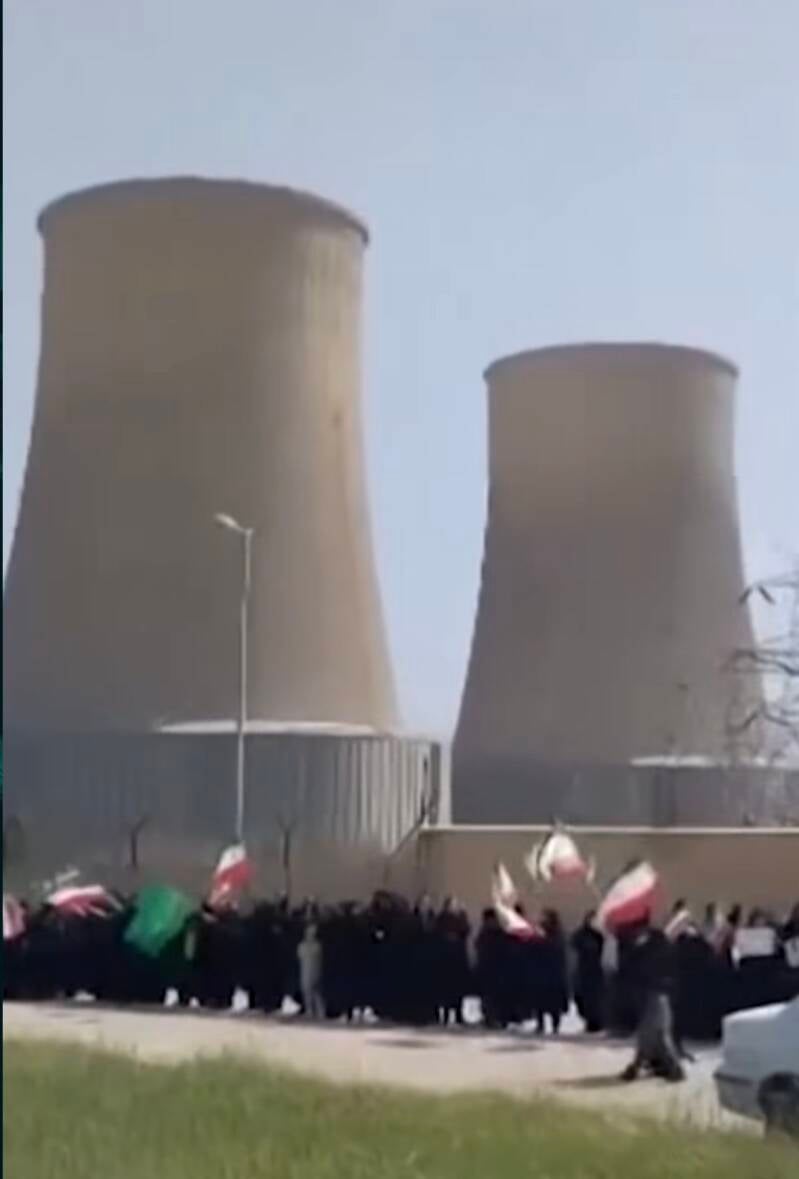
Trump continued threats toward Iran early Tuesday morning in a shocking manner as he said, “A whole civilization will die tonight, never to be brought back again…I don’t want that to happen, but it probably will.” The statement had mixed reactions. Many understand the statement to be talking about the Iranian Regime as a whole and not genocide as the ending of the statement says "God Bless the Great People of Iran!" Yet, many question and criticize the severity of the statement. Even still, others praised the statement as showing the strength of the United States and its commitment to ending the terrorist regime. FOX News is currently reporting that some Iranian citizens are gathering around powerplants.
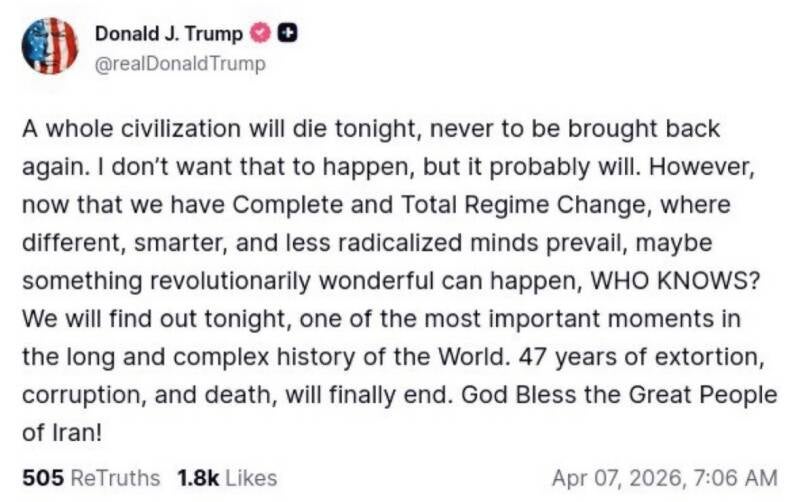
Image above taken from Donald Trump's Truthsocial account on April 7, 2026. Image to the right is an image of the reported Iranian gatherings/protests around powerplants in Iran. It is provided by FOX News.
Sources
“Iran Faces Trump’s Deadline as Infrastructure Comes Under Strain: What We Know.” CNN, 7 Apr. 2026, www.cnn.com/2026/04/07/middleeast/iran-trump-deadline-infrastructure-what-we-know
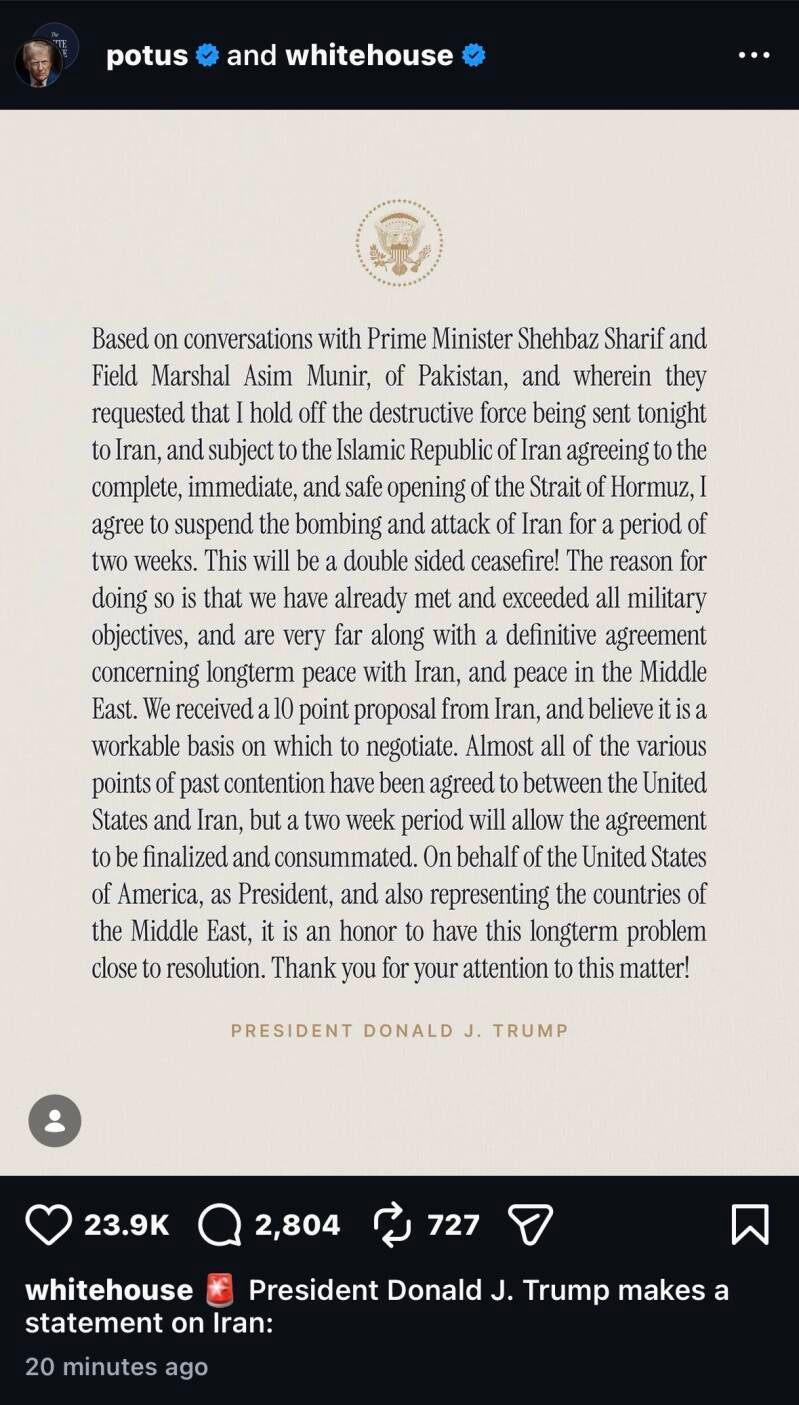
Just minutes ago at around 6:48 pm, President Trump announced on various social media platforms that after conversations with Pakistan’s prime minister and military leadership, he has agreed to pause a planned U.S. military strike on Iran. The pause is conditional: Iran must immediately and safely reopen the Strait of Hormuz. The President says he is willing to suspend military action for two weeks because U.S. forces have already achieved their objectives and because negotiations with Iran are reportedly close to producing a long‑term peace agreement. He claims Iran has submitted a ten‑point proposal that appears workable, and that most major disagreements between the two countries have already been resolved. The two‑week window is presented as the time needed to finalize this agreement. The statement ends by framing this as a significant step toward resolving long‑standing Middle Eastern tensions.
April 8, 2026 Update:
The ceasefire in Iran seems uncertain as to its validity and continuation. Defense Secretary Pete Hegseth said Wednesday that the United States will “be hanging around” despite announcing that the Pentagon’s mission in Iran is complete, stressing that American forces will remain ready to act if Iran violates the new two‑week ceasefire. He said Iran has threatened the U.S. and its allies “for 47 years” and argued that the agreement ensures Iran will “never, ever possess a nuclear weapon.” President Donald Trump said the deal bars uranium enrichment and includes a joint effort to locate and remove deeply buried nuclear material. Hegseth called it a “big day for world peace” and praised the recent U.S. military campaign, saying the operation, known as Epic Fury, “decimated Iran’s military” and left it combat‑ineffective. He said the U.S. dismantled “one of the world’s largest militaries” in under 40 days. Hegseth added that ceasefires “take time” to stabilize but said the U.S. is watching closely and remains prepared to respond if needed.
Iranian Parliament Speaker Mohammad Bagher Ghalibaf accused the United States of violating three clauses of Tehran’s 10‑point proposal before negotiations even began, saying Iran’s call for a Lebanon ceasefire was ignored, a drone entered Iranian airspace in violation of the framework, and Iran’s right to enrichment was not recognized. He argued that under these circumstances, pursuing a bilateral ceasefire or negotiations with Washington is “unreasonable.” The White House has rejected these claims, noting that Lebanon is not included in the ceasefire agreement and reiterating that uranium enrichment in Iran must end. The situation escalated further when Iranian state media reported that Tehran had once again closed the Strait of Hormuz, a move White House press secretary Karoline Leavitt called “completely unacceptable” while repeating President Trump’s expectation that the waterway be reopened. Leavitt also said Iran’s original 10‑point plan was “unserious” and discarded, but that Tehran later submitted a more realistic version that aligns more closely with the U.S. 15‑point proposal. Confusion persists because Iran has released multiple differing versions of its plans, with variations between English and Farsi texts. The White House also claims that Iranian state media’s claims publicly are vastly different from their private communication with President Trump and that no one should trust it.
These disputes come less than a day after the United States, Iran, and Israel each claimed victory following an agreement on a two‑week ceasefire meant to halt more than a month of war. Despite the truce, drones and missiles continued striking Iran and Gulf Arab states, and Israel pressed ahead with its campaign against Hezbollah in Lebanon. Israeli forces struck dense commercial and residential areas of Beirut without warning, causing significant casualties, and Prime Minister Benjamin Netanyahu said the ceasefire does not apply to operations against the terrorist organization that is Hezbollah. As a result, the ceasefire already appears fragile, strained by conflicting expectations, ongoing military activity, and competing narratives from Washington and Tehran.
Sources:
Associated Press. “Iran, U.S., Israel, Trump, Lebanon — April 8, 2026.” AP News, https://apnews.com/article/iran-us-israel-trump-lebanon-april-8-2026-38d75d5e4f1c7339a1456fc99415bb2a
Associated Press. “Iran War Ceasefire, Strait of Hormuz, Nuclear Enrichment.” AP News, https://apnews.com/article/iran-war-ceasefire-strait-hormuz-nuclear-enrichment-9f5d7fce2cf32b8513861ca872e3cfb2.
CNN. “Iran War, Trump, U.S. Ceasefire: Live Updates.” CNN, 8 Apr. 2026, https://www.cnn.com/2026/04/08/world/live-news/iran-war-trump-us-ceasefire
April 12, 2026 Update:
President Donald Trump said in a televised interview that the United States, along with several allied nations, plans to deploy both advanced and conventional minesweeping vessels to the Strait of Hormuz to clear explosive devices Iran has placed in the waterway. He added that a U.S.‑led blockade of the strait is already underway after negotiations stalled, noting that some Gulf partners are assisting, though he did not identify which ones. Trump argued that regional actors had invited trouble by firing missiles earlier in the conflict.
In a separate statement, Trump warned that American forces remain ready to eliminate what he described as the remaining elements of Iran’s military capability after peace talks in Islamabad ended without resolving key disputes. U.S. negotiators reported progress on several issues during nearly a full day of discussions but said no agreement was reached on Iran’s nuclear restrictions. Trump also vowed that the U.S. Navy would intercept any vessel attempting to pass through the strait or pay Iran for transit, emphasizing that Tehran has kept the channel largely closed since the war began.
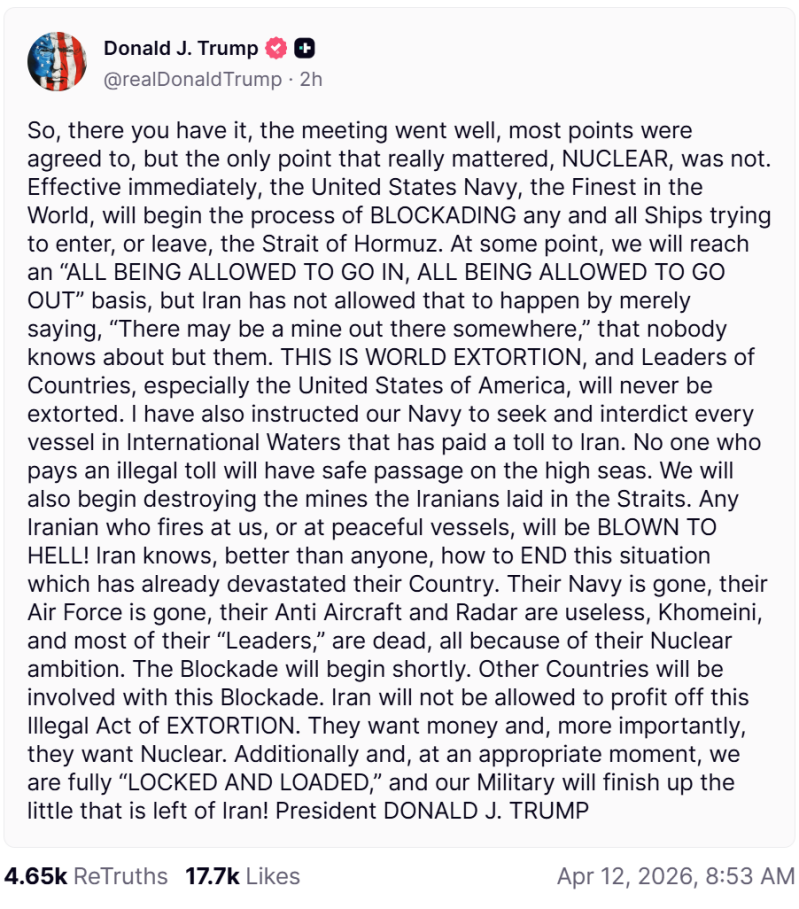
Islamabad, Pakistan: the location of peace talks between the United States and Iran