2026 Quebec Provincial Election: Outcome
10/08/2026
Samuel Clifford
How Do Quebec Elections Work?
Quebec is a representative democracy meaning citizens vote for representatives to vote for them on legislation and rule on their behalf. Québec’s democracy is based on the principle that every eligible elector has the right to vote and also that all votes are equal. To ensure fair representation, the province is divided into 127 electoral divisions, each with roughly the same number of voters. These electoral divisions correspond to the 127 seats in the National Assembly of Québec. The National Assembly of Québec is Québec’s provincial legislature, or law-making body. Its responsibilities are making laws, debating public issues, approving the provincial budget, representing citizens, and keeping the government accountable. During provincial elections, candidates from different political parties, as well as independent candidates, campaign to present their ideas and seek support from voters. Electors then vote for a candidate in their electoral division. The political party that wins the most seats forms the government, and its leader becomes the premier. A premier is the head of a provincial government in Canada, similar to how the Prime Minister leads the federal government. The premier leads the provincial government and sets its priorities. He or she also chooses cabinet ministers, who oversee areas such as health, education, and transportation. Furthermore they propose policies and laws to address issues facing the province. A government is considered a majority government if it wins at least 64 of the 127 seats; otherwise, it is a minority government.
Élections Québec.“Québec’s Electoral Systems.” Élections Québec, https://www.electionsquebec.qc.ca/en/understand/understanding-democracy-and-elections/quebecs-electoral-systems/. Accessed 7 Oct. 2026.
Raikar, Sanat Pai. "representative democracy". Encyclopedia Britannica, 11 Sep. 2026, https://www.britannica.com/topic/representative-democracy. Accessed 7 October 2026.
The Five Major Political Parties in the 2026 Election
- Parti Québécois (PQ)
This party was founded by journalist René Lévesque in 1968 in Quebec. At first it was a merging of Lévesque’s Mouvement Souveraineté-Association and other separatist groups. Early in its history it was a failure such as in the elections of 1970 and 1973. Yet, that changed in 1976 when they won 71 of 110 seats in the National Assembly. This party wants Québec to become an independent country and supports protecting the French language and Québec culture. It promotes Québec nationalism and greater provincial control over its affairs. The current leader of the party is Paul St-Pierre Plamondon.
Gall, Gerald L., Maude-Emmanuelle Lambert, and Dominique Millette.“Quebec Referendum of 1995.” Encyclopaedia Britannica, 20 Sept. 2016, https://www.britannica.com/topic/Quebec-referendum-of-1995. Accessed 7 Oct. 2026.
- Québec Liberal Party (PLQ)
The Quebec Liberal Party supports Québec remaining part of Canada. They generally favor economic growth, business development, and cooperation with the federal government. This party often receives strong support from anglophone and immigrant communities. The current leader of the party is Charles Millard.
- Conservative Party of Québec (PCQ)
The PCQ favors lower taxes, less government intervention, individual freedoms, and fiscal conservatism. Like the PLQ they support Québec remaining in Canada. They also generally promote free-market solutions. The current leader of the party is Éric Duhaime.
- Québec solidaire (QS)
The QS party is a Left-wing party that supports stronger social programs, environmental protection, and reducing inequality. They generally support Québec sovereignty but focus heavily on social justice and climate issues instead. The party's prominent leader and spokesperson is Ruba Ghazal.
- Coalition Avenir Québec (CAQ)
The CAQ is a Nationalist party that wants more autonomy for Québec while remaining part of Canada. They support protecting French language and culture, economic development, and practical reforms rather than sovereignty. The current leader of the party is Christine Fréchette.
2026 Election Outcome
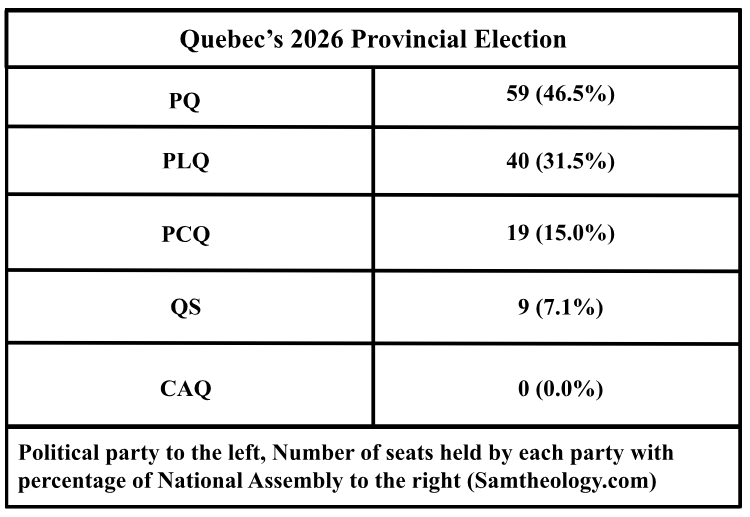
The 2026 Québec provincial election resulted in a major political shift from the results of the last election. The Parti Québécois (PQ) won the most seats in the National Assembly and is set to form the next government. Yet, even with this win the party fell short of the 64 seats needed for a majority government. This means it will govern as a minority government and must seek support from opposition parties to pass major legislation.
The Québec Liberal Party (PLQ) became the Official Opposition after winning 40 seats. The Conservative Party of Québec (PCQ) achieved its strongest result ever by winning 19 seats. Québec solidaire (QS) won 9 seats. Finally, the previously governing Coalition Avenir Québec (CAQ) suffered a historic defeat with 0 seats.
One of the most significant issues for the future is the PQ's commitment to Québec sovereignty. During the campaign, Paul St-Pierre Plamondon stated that he supports holding another referendum on Québec independence during his term. If this occurs, it would be the third sovereignty referendum in Québec's history, following those held in 1980 and 1995. However, the PQ leads a minority government, its ability to advance its agenda will depend on cooperation with opposition parties. The Liberals strongly support Québec remaining within Canada, while the Conservatives and Québec solidaire may support or oppose government proposals depending on the issue. As a result, political negotiations and compromise will likely play a major role in the coming years.
In summary, the 2026 election brought the Parti Québécois back to power, revived discussion about Québec sovereignty, and created a minority government that will need support from other parties to govern effectively. The future of Québec politics may depend on whether the government can maintain legislative support and whether public backing for sovereignty continues to grow.