Japan: Growing Shipbuilding Industry
04/10/2026
Samuel Clifford
Introduction:
Japan used to be the world leader in shipbuilding and commanded more than 35% of all new global shipbuilding orders around the 1970s to 1980s. Since that time, however, China and South Korea have surpassed Japan in this industry to where in 2025 Japan’s share had fallen to just over 10%. Now, as of April 2026, Japan plans on revitalizing its shipbuilding industry with an investment of 1 trillion yen (6.3 billion U.S. dollars). Japan’s economy relies on ships for 99.6% of its trade, including nearly all food and energy imports. A weakened domestic shipbuilding sector threatens supply-chain resilience. The decline in Japan’s ship building industry has left Japan unable to meet even domestic shipowner demand.
Japan’s Plan to Revitalize Its Shipbuilding Industry:
Prime Minister Sanae Takaichi frames shipbuilding revitalization within “responsible and proactive public finances,” emphasizing preparedness for crises. Japan has therefore constructed a plan to revitalize its shipbuilding industry by 3025. The first phase of Japan’s 2035 roadmap centers on reversing decades of declining productivity by aggressively introducing automation and labor‑saving technologies. Between 2026 and 2028, the government will deploy the initial ¥120 billion from the new shipbuilding fund to support the adoption of welding robots, AI‑driven production systems, and other advanced manufacturing tools. This phase directly targets Japan’s structural disadvantages of high labor costs, an aging workforce, and fragmented production processes by modernizing shipyards and reducing dependence on manual labor. The goal is to create a technological foundation capable of competing with the highly efficient, state‑supported shipyards of China and South Korea.

Japan's Prime Minister Sanae Takaichi
The second phase shifts from digital modernization to large‑scale physical expansion. From 2029 to 2031, Japan will invest heavily in constructing and enlarging core shipyard infrastructure, including docks, large cranes, and long‑lead‑time equipment. This phase is essential because Japan’s current shipbuilding capacity cannot meet domestic shipowner demand, let alone support a global competitive resurgence. By rebuilding and expanding facilities, Japan aims to restore the industrial scale it once possessed in the late 20th century, when it accounted for nearly half of global shipbuilding output. These upgrades are designed to prepare shipyards for the high‑volume production required to reach the 2035 target of 18 million gross tons annually.
The final phase focuses on bringing Japan’s revitalized shipbuilding ecosystem fully online. Between 2032 and 2034, newly expanded docks, upgraded cranes, and automated production lines will enter full operation, enabling shipyards to scale output to levels not seen in decades. This phase also includes support for advanced technologies tied to next‑generation and zero‑emission vessels, aligning Japan with emerging global decarbonization standards. By integrating expanded physical capacity with the technological gains of Phase 1, Japan aims to restore its position as a major shipbuilding nation and ensure long‑term resilience in maritime logistics, economic security, and defense cooperation, particularly with the United States.
Concerns:
Rebuilding capacity will take years, and success depends on whether shipowners have compelling reasons to place orders in Japan rather than in cheaper or more efficient foreign yards. Experts suggest Japan may need to pivot toward high‑end, technologically advanced vessels rather than trying to compete on volume, a strategy already used in Europe and South Korea.
Conclusion:
Japan’s renewed push to rebuild its shipbuilding industry represents more than an economic initiative, it is a strategic effort to secure national resilience in an era of geopolitical and technological competition. After decades of decline, the 2035 roadmap lays out a coherent, phased plan that tackles Japan’s core structural weaknesses: labor shortages, aging infrastructure, and insufficient production capacity. By combining automation, large‑scale facility expansion, and next‑generation vessel technologies, Japan aims not only to double output but to reposition itself as a leader in high‑value, technologically advanced ship construction.
Yet the path forward is not guaranteed. Japan must convince shipowners that its revitalized yards offer advantages strong enough to offset higher costs and global competition. Success will likely depend on Japan’s ability to differentiate, focusing on innovation, quality, and specialized vessels rather than competing on volume alone. If Japan can execute this strategy, its shipbuilding revival could strengthen national security, reinforce supply‑chain independence, and reestablish Japan as a major maritime power in the Indo‑Pacific.
Sources:
Breakwave Advisors. “Japan’s Shipbuilding Industry.” Breakwave Advisors, 30 Oct. 2025, www.breakwaveadvisors.com/insights/2025/10/30/japans-shipbuilding-industry
The Japan News – Yomiuri Shimbun. “Yomiuri Editorial.” The Japan News, 16 Feb. 2026, https://japannews.yomiuri.co.jp/editorial/yomiuri-editorial/20260216-311699/.
Ryall, Julian. “Can Japan Regain Shipbuilding Might with US$6.3 Billion Funding Plan?” South China Morning Post, 10 Apr. 2026, www.scmp.com/week-asia/politics/article/3261234/can-japan-regain-shipbuilding-might-us63-billion-funding-plan
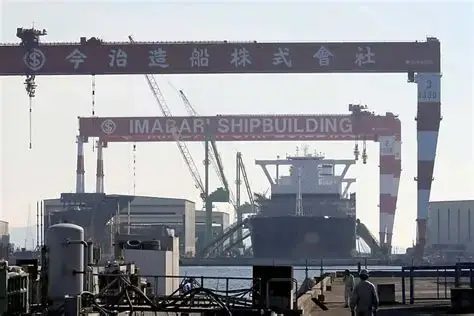
The Marugame Headquarters of Imabari Shipbuilding Co. is seen in Marugame, Kagawa Prefecture, in July 2021.