Pyrrhonian Skepticism v Academic Skepticism
05/07/2026
Samuel Clifford
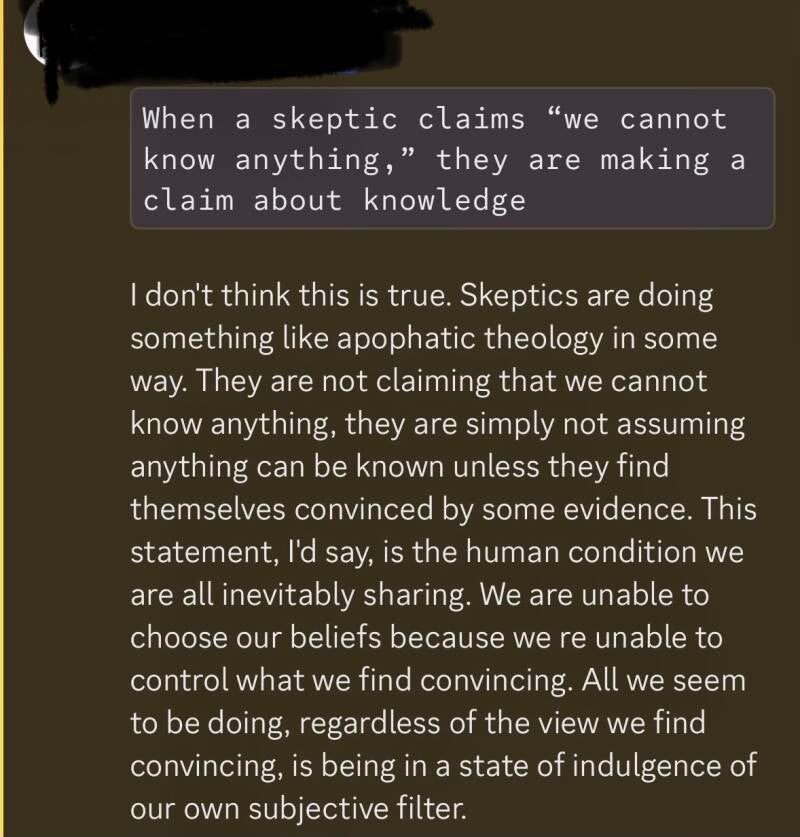
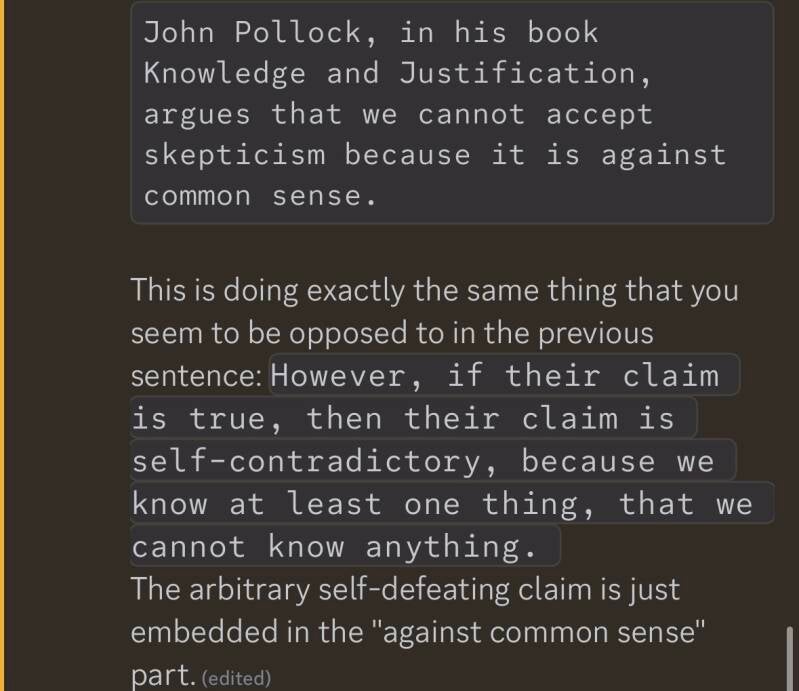
After uploading my article a few days ago on what knowledge is and if we can know anything, I asked a few philosophy friends in a group chat I am in to come up with objections or problems so that I could answer. Here is one of the objections I received.
This objection can be resolved with simply providing clarity about the previous article. Firstly, the previous article was not refuting Pyrrhonian skepticism (the philosophical stance that one should suspend judgment about all non‑evident matters because opposing arguments appear equally persuasive) but instead Academic Skepticism (the view that knowledge is impossible and that humans must instead rely on varying degrees of plausibility when forming beliefs). Pyrrhonian skepticism, therefore, does not fall under the self defeating problem presented in the last article while Academic Skepticism does.
The statement “we are unable to choose our beliefs because we cannot control what we find convincing,” is perhaps psychologically plausible, but it doesn’t rescue the academic skeptic from self‑defeat. This statement certainly deserves more attention at a latter time but it isn’t truly relevant to the article prior. It doesn’t matter whether the skeptic feels compelled to believe their skeptical thesis. What matters is whether the thesis is coherent.
Furthermore, the objector treat Pollock’s appeal to common sense as equivalent to the self‑defeat argument. But they are fundamentally different kinds of arguments. The self-defeat argument aims to show that the skeptical thesis is logically incoherent. The common-sense argument aims to show that the skeptical thesis is pragmatically unacceptable.