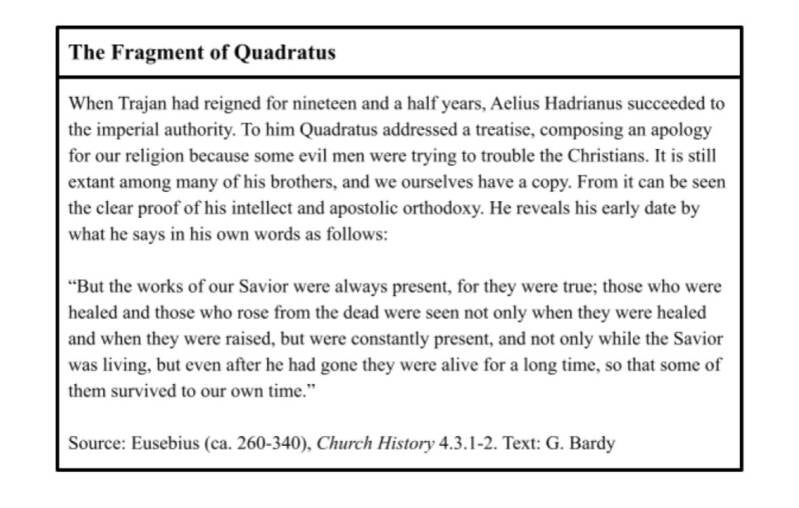
The Fragment of Quadratus
02/15/2026
Samuel Clifford
Most of what we know about St. Quadratus comes from Eusebius (Church History 4.3.1-2), who preserved the only surviving fragment of his work. We know that he was one of the first Christian apologists (along with Aristides). He reports that Quadratus wrote “an apology for our religion” during the early reign of the emperor Hadrian (117-138). Eusebius believed the apology was “clear proof of his intellect and apostolic orthodoxy.” Both Eusebius and Jerome (Famous Men 19) believed Quadratus was located in Athens. However, there is debate whether this Quadratus is the same Quadratus mentioned as the Bishop of Athens in 180 A.D.
The surviving fragment of Quadratus highlights the concrete, enduring reality of Jesus’ miracles, likely as a counter to rival claims of miraculous powers attributed to others. Beyond this brief glimpse, however, we have no knowledge of the broader argument or structure of his apology.
Quadratus addressed his work to the emperor Hadrian, and so was writing in or after 117 A.D., but by our “own times” he presumably means not when he wrote but a time earlier. Evidently he was of the same generation as Papias. The period of which it could be credibly said that some people healed by Jesus were still alive would be the same period toward the end of the first century in which Papias was collecting traditions, including some from two disciples of Jesus still living. Quadratus, by not mentioning their names, likely expected his readers to know of some of the recipients of Jesus’ miracles such as Bartimeus who was healed from his blindness (Mark 10:46-52). This, then, provides us with evidence of Jesus’ miracles. Why would Quadratus use the eyewitness of the recipients of Jesus’ miracles to refute attacks on the Christian religion if they weren’t around or didn’t exist at all?