The Haudenosaunee: A Historical Introduction
09/21/2026
Samuel Clifford
Who Were The Haudenosaunee (Iroquois)?
The Haudenosaunee is a confederation of five, or six depending on the specific time being discussed, Native American Tribes that primarily lived in the region of New York State. The tribes included the Mohawk, Oneida, Onondaga, Cayuga, Seneca, and later in the 18th century the Tuscarora. The confederacy’s origin is somewhat unknown, especially concerning the date due to the oral traditions of their culture, but it is estimated to have started between the 12th and 15th century according to traditional Haudenosaunee accounts.
The Structure of The Haudenosaunee
The name “Haudenosaunee” means “The People of the Longhouse” due to the buildings these people constructed as their homes. They used to be commonly known, and still somewhat are known, as the Iroquois, which is a name given to them by their adversaries and means “black snakes” or “real snakes.” The way the overall political confederacy functioned mirrored how individual clans and tribes functioned. The clans and tribes were a matriarchy with a clan mother at the head. The clan mother was the head of a longhouse and all of her female descendants,

including her sisters, daughters, and sisters daughters would live in the longhouse their entire lives as their husbands would live with them in the longhouse. Male descendants would stay in the longhouse until they married someone outside the longhouse, in which case they would then join their bride's house. According to tradition, women would handle village concerns such as property, etc. Men, on the other hand, took care of hunting, fishing, and trading concerns.
Many clans would make up a moiety and two moieties made up a nation. Members of one moiety often had special social, political, ceremonial, or marriage relationships with members of the other moiety.
The clan mother would appoint four different types of chiefs that could be removed by her at any time and for any reason. These chiefs were:
- Civil Chief (Over Settlements)
- War Chief (Over War Planning)
- Peace Chief (Over Diplomacy)
- Sachems

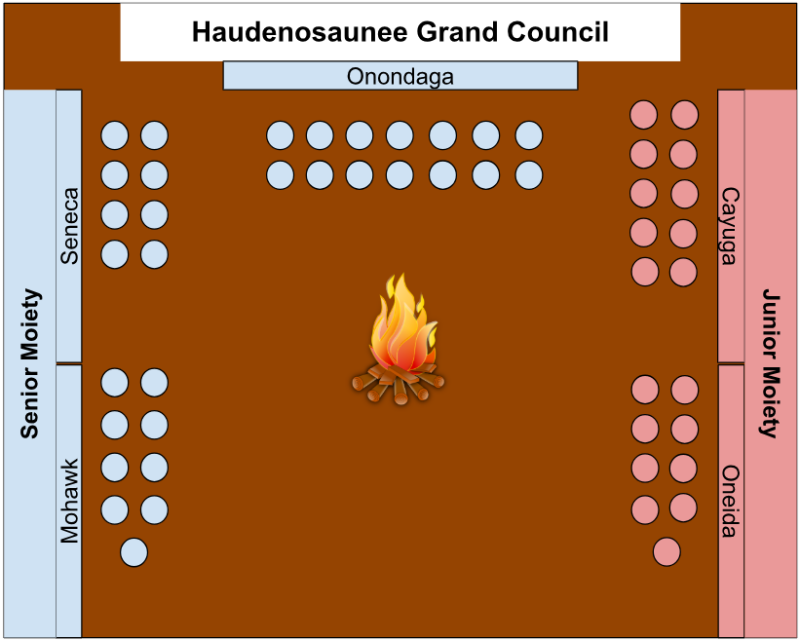
The Sachems were representatives for the grand council of the confederacy. The confederacy consisted of 5 or 6 tribes and formed a grand council to deal with matters that affected the entire confederacy. The council consisted of 50 sachems (the Seneca had 8, the Mohawk had 9, the Oneida had 9, the Onondaga had 14, the Cayuga had 10).
The council was split into two moieties with the first (Senior) moiety consisting of the Mohawk, Seneca, and Onondaga. The second (Junior) moiety consisted of the Cayuga and Oneida. When the Tuscarora joined in 1722 they did not receive the same voting representation on the council as the original five members. The Onondaga were considered the firekeepers and remained keeping the fire even when the council was not in session. As the keepers of the central fire, they served as mediators between the two moieties and played a crucial role in maintaining unity within the Confederacy.
A sachem would bring forward a thing whether it was a trade agreement or treaty for the council to discuss. For the sake of discussion let's just say it is a trade agreement on corn. The sachem would bring forward the idea and then his own nation's sachems would have to agree on it and come to a consensus. If they did not the matter would be dropped or reviewed further. If a consensus was reached it would then go to the moiety the nation was in. If a consensus wasn’t reached then it would be dropped or reviewed further. If the moiety came to a consensus then it would go to the other moiety for consensus. If a consensus wasn’t reached then it would be dropped or reviewed further. If a consensus was reached then it would go to the Onondaga for adoption or to be reviewed further. What is interesting about this is that the two largest nations, the Mohawk and Seneca (figure 1) were on the same moiety. It seems that in order to avoid a civil war between the Mohawk and Seneca that would drag other nations on the council into the war that they were put on the same moiety so that they would have to come to a consensus before bringing in the other nations for thought.
The images and paintings above belong to Samtheology.com but are allowed to be used by others.