Vanuatu: Geography
05/09/2026
Samuel Clifford
Overview:
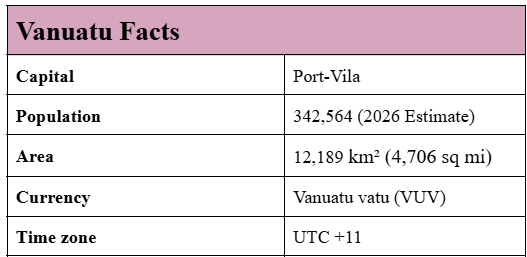
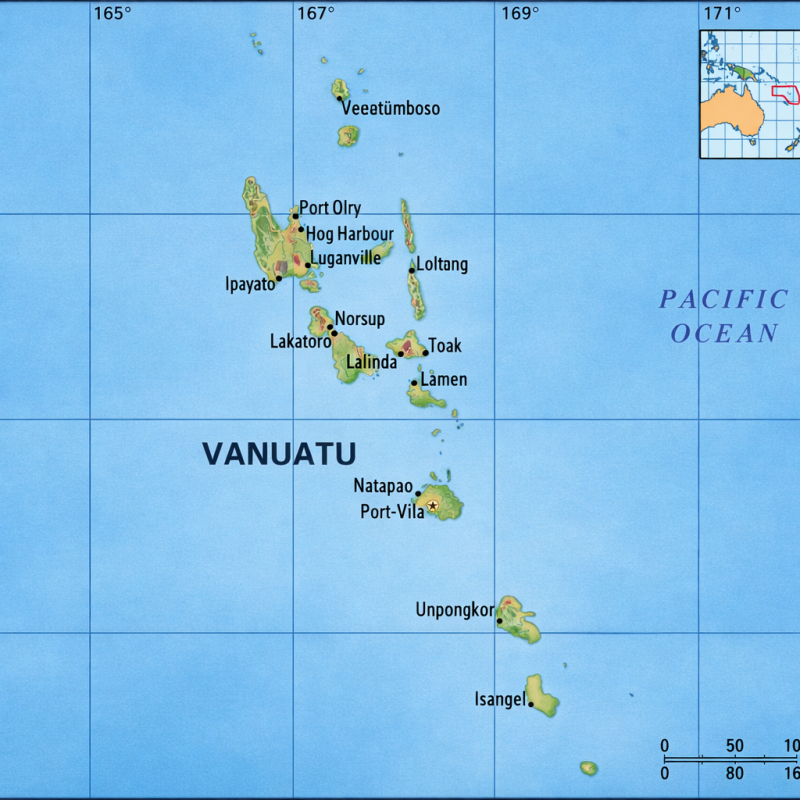
Vanuatu is a country in the southwestern Pacific Ocean that consists of around 83 islands although only 63 are inhabited. Its most significant islands are Éfaté (where the capital is located), Espiritu Santo, and Tanna. The islands of Vanuatu vary in sizes from large mountainous islands to many much smaller ones. Around 20-22 percent of Vanuatu’s population lives on the island Éfaté.
The capital of Vanuatu is Port-Vila and it is the largest town of the republic of Vanuatu. Vanuatu’s Port‑Vila sits along Mélé Bay on Éfaté’s southwest coast and serves as the economic heart of the entire archipelago. Even though the city shows strong French influence in its layout and architecture, its residents come from a wide mix of backgrounds, including ni‑Vanuatu, British, French, Chinese, and Vietnamese communities. As a busy commercial port, Port‑Vila supports hospitals, hotels, casinos, open‑air markets, sports facilities, cultural institutions, and educational centers such as a University of the South Pacific campus, along with several processing plants tied to the region’s meat and fishing industries.
Notable Historical Events of Port-Vila:
- Port‑Vila was the administrative center of one of the world’s strangest colonial governments, where Britain and France jointly ruled the New Hebrides but kept separate laws, police forces, and courts.
- Although not a major battlefield, Port‑Vila became an important Allied supply and staging point during World War II.
- The city has been repeatedly damaged by major tropical cyclones, including Cyclone Uma (1987) and Cyclone Pam (2015), both of which reshaped the city’s development and disaster‑preparedness systems.
- In 1980, Port-Vila became the capital of the new Republic of Vanuatu after decades of colonial tension and local resistance.
Borders:
Vanuatu maintains a consistently positive relationship with all the countries that share its maritime borders. As a small Pacific nation, it places strong emphasis on regional cooperation, cultural ties, and collective approaches to climate resilience. Its diplomacy is generally warm and pragmatic, especially with its closest neighbors.
Solomon Islands, located to the north of Vanuatu, is one of its closest Melanesian partners. The two countries share cultural heritage, linguistic similarities, and long‑standing people‑to‑people connections. They work together through regional bodies such as the Melanesian Spearhead Group and the Pacific Islands Forum. Their maritime boundary was formally agreed upon in 2016, and relations remain stable, with cooperation in fisheries, security, and disaster response.
Fiji, to the west of Vanuatu, is another major regional partner. Both nations share strong cultural and economic ties and frequently coordinate on issues such as climate change, labor mobility, and regional diplomacy. Fiji is a hub for Pacific aviation and trade, making it an important link for Vanuatu’s connectivity. Relations are friendly, and there are no territorial disputes or long‑term political tensions between them.
Australia, lying to the east of Vanuatu, is one of Vanuatu’s most significant development and security partners. Australia provides substantial support in infrastructure, education, health, and emergency response. While Vanuatu sometimes takes independent positions on regional politics, the overall relationship is cooperative and mutually beneficial. Australia also plays a major role in post‑cyclone recovery efforts and maritime safety.
New Caledonia, directly to the south of Vanuatu, shares deep cultural and historical ties through their shared Melanesian identity. As a French territory, New Caledonia and Vanuatu collaborate on maritime boundaries, environmental protection, and cultural exchange. Their maritime border was settled in 2011, and relations remain friendly and stable. Cooperation is especially strong in areas such as fisheries management and regional cultural initiatives.
Overall, Vanuatu’s relationships with its maritime neighbors are overwhelmingly positive. Its foreign policy emphasizes regional solidarity, cultural connection, and peaceful cooperation across the South Pacific.
Imports and Exports:
Vanuatu has one of the smallest economies in the world, ranking 187th globally in GDP with a total output of 1.12 billion (current USD) in 2024. Despite its size, the country plays an active role in regional and international trade. It stands 175th in total exports and 139th in GDP per capita, reflecting both its economic constraints and its reliance on external markets. Trade is a central pillar of Vanuatu’s development strategy, accounting for around 69% of national GDP, and the country has steadily integrated itself into global and regional trade frameworks to support long‑term growth.
Vanuatu’s export sector is dominated by natural and marine products. In 2024, its leading exports included Non‑fillet Frozen Fish, Special Purpose Ships, Perfume Plants, Molluscs, and Cocoa Beans. These goods primarily flowed to major Asian markets, with Thailand, Japan, China, the United States, and the Philippines serving as the top destinations. On the import side, Vanuatu relies heavily on essential goods such as Refined Petroleum, Fishing Ships, Delivery Trucks, Poultry Meat, and Cars. Its largest import partners were China, Malaysia, Australia, New Zealand, and Fiji, underscoring the country’s dependence on regional suppliers for fuel, machinery, and food products.
Vanuatu’s commitment to trade liberalization is reflected in its participation in several major agreements. The country joined the World Trade Organization in 2012 after a lengthy accession process, signaling its intention to align with global trade norms and expand market opportunities. Its national trade policy framework integrates free‑trade principles into broader development goals, including the Priority Action Agenda, with the aim of improving investment flows, resource efficiency, employment, and income generation.
At the regional level, Vanuatu is a member of the Melanesian Spearhead Group Free Trade Agreement (MSGFTA), which includes Papua New Guinea, Fiji, and the Solomon Islands. Under this agreement, Vanuatu has fully liberalized its tariff schedule since 2013, allowing duty‑free access for goods that meet the MSG Rules of Origin criteria. This framework supports intra‑Melanesian trade by ensuring that qualifying products can move freely among member states.
Vanuatu has also signed the Pacific Island Countries Trade Agreement (PICTA), though actual trade under this agreement remains limited. As a least‑developed country, Vanuatu’s tariff‑reduction commitments began in 2009, but most regional trade continues to occur through the MSG framework rather than PICTA. The PICTA Rules of Origin rely on a 40% local value‑added requirement, and the agreement is administered domestically through the Department of Foreign Affairs.
The country is also a signatory to PACER Plus, a development‑focused free trade agreement designed to deepen economic integration between Pacific Island nations and partners such as Australia and New Zealand. Vanuatu signed the agreement in September 2017, joining a group of Pacific states committed to improving trade facilitation, investment conditions, and regional cooperation.
Beyond the Pacific, Vanuatu participates in negotiations for the ACP‑EU Economic Partnership Agreement, working alongside other Pacific Island countries to shape future trade relations with the European Union. While Vanuatu has not yet finalized its position, ongoing engagement ensures that the country remains involved in shaping the region’s long‑term trade architecture.
Overall, Vanuatu’s trade landscape reflects a small but outward‑looking economy that relies heavily on international markets and regional cooperation. Through its participation in global institutions and Pacific trade agreements, Vanuatu continues to pursue strategies aimed at strengthening economic resilience, expanding export opportunities, and integrating more deeply into the regional and global economy.
Vanuatu Customs and Inland Revenue Department. “Free Trade Agreements.” Customs Inland Revenue, Government of Vanuatu, https://customsinlandrevenue.gov.vu/customs/customs-revenue/free-trade-agreements.html.
Observatory of Economic Complexity (OEC). “Vanuatu.” OEC, https://oec.world/en/profile/country/vut.
Lloyds Bank. “Vanuatu: Trade Profile.” Lloyds Bank International Trade Portal, https://www.lloydsbanktrade.com/en/market-potential/vanuatu/trade-profile.
Environment:
Vanuatu’s environments are among the most diverse and dynamic in the South Pacific, shaped by its volcanic origins and tropical climate. The archipelago consists of more than eighty islands, many of which are mountainous and covered in dense rainforest. These forests support a wide range of endemic species, including birds, reptiles, and plants found nowhere else on Earth. The islands’ volcanic soils are rich and fertile, sustaining agriculture such as coconuts, taro, and yams, while active volcanoes like Mount Yasur on Tanna Island continually reshape the landscape. Rivers and waterfalls cut through the interior, feeding lush valleys and providing freshwater to communities that often rely on traditional subsistence farming.
Surrounding the islands are coral reefs and lagoons that form one of the most biologically vibrant marine ecosystems in the Pacific. These coastal environments are vital for fishing, tourism, and protection against erosion, yet they are increasingly vulnerable to climate change, rising sea levels, and coral bleaching. Mangrove forests line many shores, acting as natural buffers against storms and providing nurseries for fish. Inland, the ecosystems transition from coastal wetlands to montane cloud forests, creating a striking vertical gradient of biodiversity. Together, Vanuatu’s terrestrial and marine environments illustrate the delicate balance between natural beauty and environmental fragility, a balance that local communities work hard to preserve through sustainable practices and traditional stewardship.
Environmental Issues:
Vanuatu faces several environmental challenges that stem from human activity and resource management. One of the most significant issues is plastic pollution, which has historically affected the nation’s coastlines and marine ecosystems. According to The Guardian (June 2024), Vanuatu implemented one of the world’s most ambitious bans on single‑use plastics, including straws, bags, and polystyrene containers, after recognizing how plastic waste was choking waterways, harming coral reefs, and threatening fish populations vital to local communities. This initiative drastically reduced plastic litter and became a model for other Pacific nations, showing how strong legislation and community engagement can protect fragile island environments.
Beyond plastics, Vanuatu also struggles with deforestation, soil erosion, and waste disposal. Expanding agriculture and logging have led to forest loss, which destabilizes slopes and increases sediment runoff into rivers and coastal areas. In urban centers like Port Vila and Luganville, limited landfill capacity and informal dumping contribute to land and water contamination. These problems highlight the tension between development and conservation in a country whose economy and culture depend heavily on natural resources.
McGarry, Dan. “How the Small Pacific Island Nation of Vanuatu Drastically Cut Plastic Pollution.” The Guardian, 20 June 2024, www.theguardian.com/environment/article/2024/jun/20/how-the-small-pacific-island-nation-of-vanuatu-drastically-cut-plastic-pollution
Climate:
Vanuatu has a warm, humid tropical climate shaped by its position in the southwest Pacific and the influence of the surrounding ocean. Temperatures remain fairly steady throughout the year, generally ranging from the upper 70s to mid‑80s Fahrenheit, with only slight seasonal variation. The islands experience a distinct wet season from November to April, when moist trade winds bring frequent rainfall and thunderstorms, and a drier, more settled season from May to October. Because the archipelago stretches across several degrees of latitude, rainfall patterns vary from island to island, northern islands tend to be wetter, while some southern islands experience longer dry spells. Overall, Vanuatu’s climate supports lush vegetation, rich agricultural soils, and vibrant marine ecosystems, making it one of the most biologically diverse island groups in the Pacific.
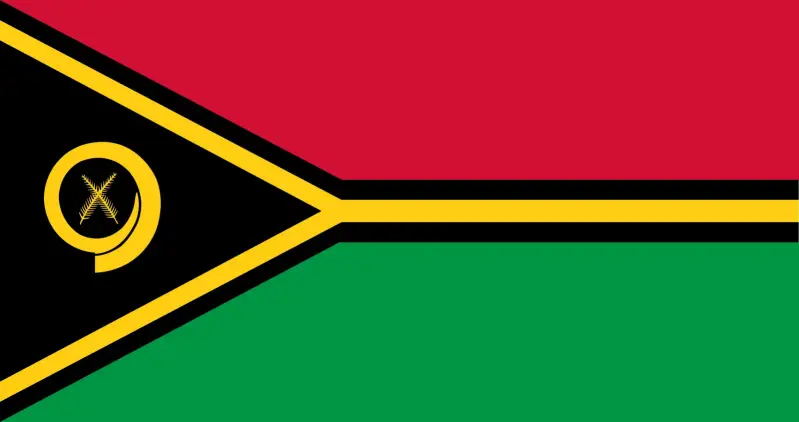
Flag of Vanuatu:
Additional Resources: