Solomon Islands: Geography
10/20/2026
Samuel Clifford
Overview:
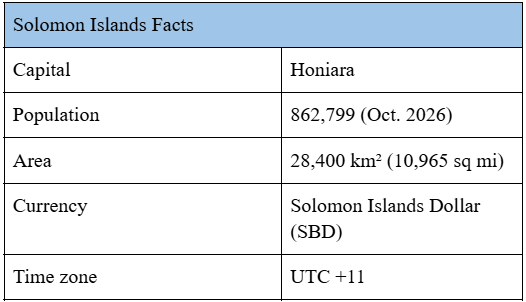
The Solomon Islands are a country in the southwestern Pacific Ocean that consists of volcanic islands and coral atolls. An atoll is a ring shaped island with a coral rim and a lagoon. The number of islands within Solomon Islands is 992 islands, of which 147 are inhabited. The six major islands are Choiseul, Guadalcanal, Malaita, Makira, New Georgia, and Santa Isabel. The capital, Honiara, is located on the largest island, Guadalcanal which also has the largest population of the country at 283,591 which is around 32.9% of the total population. Honiara is served by the Honiara International Airport and seaport at Point Cruz as means of access. Point Cruz is Honiara’s commercial and financial foundation as it acts as the primary deep-water harbor for international container ships, importing essential goods, machinery, and fuel (the nearby South Pacific Oil depot imports over 85 million liters of fuel annually). Interestingly, Honiara did not exist before World War II; it grew around a major U.S. military base and headquarters established during the conflict. The British administration moved the capital of the Solomon Islands from the war-damaged town of Tulagi to Guadalcanal in 1952. The area already had roads, port facilities, and an airfield built by U.S. forces during the Guadalcanal Campaign, which helped it grow quickly as the country's administrative, economic, and cultural center. Over time, increasing population and development transformed Honiara into the Solomon Islands' largest city and national capital.
Borders:
The Solomon Islands have no land borders as they are completely surrounded by water. However, they do share maritime borders with many other countries in the Southwestern Pacific.
To the southeast is Vanuatu and Fiji. Vanuatu shares strong Melanesian cultural ties with the Solomon Islands, while Fiji serves as a major regional hub for trade, transportation, education, and diplomacy. Cooperation with both countries centers on climate change advocacy, disaster response, fisheries management, labor mobility, and regional security. Relations are warm and stable, reflecting shared interests as Pacific island nations and frequent collaboration through regional organizations.
To the south and southwest, the Solomon Islands maintains maritime boundaries with New Caledonia, a French territory, and Australia. These relationships are important for maritime security, economic development, fisheries management, and environmental protection. Australia is one of the Solomon Islands' largest aid and development partners and has played a significant role in supporting governance and stability in the country. Through New Caledonia, France remains an active participant in Pacific regional affairs, creating opportunities for cooperation on security and conservation issues. Relations with both partners are generally positive and based on shared regional interests.
To the north and east, the Solomon Islands shares maritime boundaries with Nauru and Tuvalu. While interactions are less extensive than those with larger neighbors, all three countries cooperate closely through Pacific regional organizations. Common priorities include climate resilience, sustainable fisheries, ocean governance, and economic development. Their relationship is characterized by regional solidarity and a shared commitment to addressing the unique challenges facing small island states in the Pacific.
Papua New Guinea, located west of the Solomon Islands, is its closest and most significant maritime neighbor. The two countries share deep historical, cultural, and ethnic connections, particularly among communities near their maritime boundary. Cooperation focuses on fisheries management, border security, trade, and regional diplomacy, and both nations are influential members of the Melanesian Spearhead Group and the Pacific Islands Forum. Relations are generally friendly and cooperative, though both governments occasionally work together to address challenges such as illegal fishing and cross-border crime.
Imports and Exports:
The Solomon Islands has a small developing economy valued at approximately $1.58 billion in GDP in 2024. Despite its relatively small size, the country plays an important role in regional trade through the export of natural resources. Economic activity is concentrated in the primary sector, particularly logging, fishing, and mining, making the economy highly dependent on global demand for raw materials.
Exports are dominated by natural resources, with rough wood ($291 million) accounting for the largest share of export earnings. Other major exports include processed fish ($88.2 million), gold ($86.4 million), precious metal ores ($75.7 million), and nickel ore ($39 million). This export profile shows that the Solomon Islands relies heavily on extracting resources rather than manufacturing finished products. The country's largest export market is China, which purchases more than half of all exports, particularly timber, while Australia and several European countries are also significant buyers.
Imports reveal the nation's dependence on foreign-produced goods and energy. The largest import is refined petroleum ($104 million), which powers transportation, industry, and electricity generation. The country also imports vehicles, construction equipment, machinery, and food products such as poultry. Major suppliers include China, Singapore, and Australia, reflecting the Solomon Islands' close economic connections with the broader Asia-Pacific region.
The economy faces several challenges. Heavy reliance on logging raises concerns about deforestation and the long-term sustainability of timber exports. Because the country imports much of its fuel, machinery, and manufactured goods, it is vulnerable to disruptions in global supply chains and fluctuations in international prices. Additionally, as an island nation, the Solomon Islands is particularly exposed to natural disasters and climate change, which can damage infrastructure, agriculture, and fisheries.
At the same time, the country possesses significant opportunities for growth. Expanding mining operations, developing sustainable fisheries, increasing tourism, and investing in infrastructure could help diversify the economy and reduce dependence on logging. Overall, the Solomon Islands remains a resource-rich but economically vulnerable nation whose future prosperity will depend on balancing resource development with long-term sustainability and economic diversification.
Environment and Environmental Issues:
The Solomon Islands are an archipelago of nearly 1,000 islands located in the southwestern Pacific Ocean, northeast of Australia and east of Papua New Guinea. The country is known for its rugged volcanic islands, dense tropical rainforests, mountain ranges, rivers, mangrove swamps, and extensive coral reefs. Many islands are covered by thick forests that support a rich variety of plant and animal life, including numerous species found nowhere else in the world. The warm tropical climate brings high temperatures and abundant rainfall throughout the year, helping create lush vegetation and productive ecosystems.
The surrounding marine environment is equally important. The Solomon Islands lie within the Coral Triangle, one of the most biodiverse marine regions on Earth, with vibrant coral reefs, seagrass beds, and rich fishing grounds. These waters support hundreds of species of fish, sea turtles, sharks, dolphins, and other marine life, making fishing a major part of the economy and daily life. However, the environment faces challenges from deforestation, overfishing, climate change, and rising sea levels. Tropical cyclones, earthquakes, and occasional tsunamis also pose natural hazards due to the islands' location along the Pacific “Ring of Fire.” Despite these challenges, the Solomon Islands remain one of the most ecologically diverse and naturally beautiful countries in the Pacific region.
Climate:
The Solomon Islands have a warm, humid tropical climate shaped by their location near the equator and the influence of the surrounding Pacific Ocean. Temperatures remain relatively constant throughout the year, generally ranging from the upper 70s to mid-80s Fahrenheit, with little seasonal variation. The islands experience a wet season from November to April, when heavy rainfall, thunderstorms, and occasional tropical cyclones are most common, and a relatively drier season from May to October. High humidity and abundant rainfall support dense tropical rainforests and productive coastal ecosystems across much of the archipelago.
Because the Solomon Islands consist of hundreds of islands spread across a large area, local weather conditions can vary significantly. Mountainous islands often receive especially heavy rainfall as moist ocean air rises over the terrain, while some smaller islands experience slightly drier conditions. The warm climate and fertile soils support rich biodiversity, including extensive rainforests, mangrove swamps, and some of the world's most diverse coral reef systems. Overall, the Solomon Islands' climate sustains abundant plant and animal life, productive fisheries, and agricultural activities, making the environment one of the country's most important natural resources.