Ekklesia: Meaning v Application
04/29/2026
Samuel Clifford
Introduction:
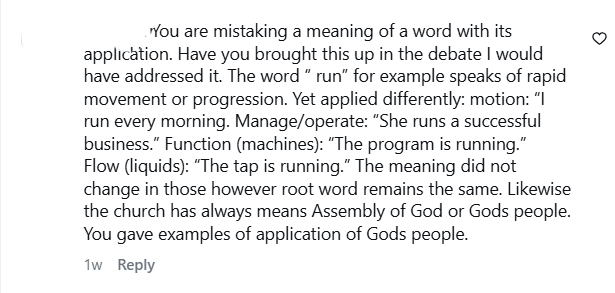
A few months after my Ekklesia in Scripture debate, a person commented on one of my socials giving me his problems with my argument. This person had before debated my friend Jacob Fain on this subject. I wanted to address this in an article in case others have similar concerns. One of the main ways linguists determine the definitions of words in ancient texts is by how they are used in ancient texts. When a word appears in inscriptions, manuscripts, or tablets, scholars examine the structure of the sentence, nearby words, its usage across different texts, and the cultural or ritual context. This is rooted in philology, the study of ancient documents. Etymology and the Comparative Method are also common ways of determining a word's meaning in ancient dialects. With this in mind, the commenter states that the “church” or “ekklesia” always means Assembly of God or God's people and that the examples given in my article are also examples. However, it is shown by various texts that this cannot be the overall meaning of the words.
Firstly, in my original article I showed that the word ekklesia as used in Acts 19 cannot be about the assembly of God. You can read about that here:
Secondly, beyond scripture there are other ancient texts that use the term ekklesia. Let’s examine a few of those below:
- Thucydides
“Upon this the Athenians held an assembly (ἐκκλησίαν), and laid the matter before their consideration. It was resolved to deliberate once for all on all their demands, and to give them an answer.” Thucydides 1.139.1
Not only do historians translate ekklesia to mean assembly in this verse, but the context shows it cannot be used in this passage to mean “assembly of God.” In this section the writer Thucydides states that the Spartans sent multiple embassies to Athens and each delivered increasingly firm demands which ended the siege of Potidaea, recognized Aegina’s independence, and revoked the Megarian Decree. Athens rejected these demands, accusing the Megarians of sacrilege and harboring runaway slaves. Finally, the Spartan envoys presented an ultimatum: peace will continue only if Athens allows all Greeks to remain independent. In response to this ultimatum, the Athenians convened an ekklesia, the formal civic assembly of Athenian citizens, to consider the matter. The text describes citizens gathering, debating, and voting on how to answer Sparta. Many speakers argue for different courses of action, and Pericles himself rises to address the people. This scene demonstrates that ekklesia refers to the official democratic assembly where Athenian citizens met to deliberate, debate, and decide state policy.
- Herodotus
“When the Persians had assembled (ἐν τῇ ἐκκλησίῃ), Otanes spoke as follows: ‘It does not seem good to me that one man should rule over all…’” Herodotus, Histories 3.83
Herodotus is describing a political debate among Persian nobles after the overthrow of the Magian usurper. The seven conspirators gather to decide what form of government Persia should adopt, monarchy, oligarchy, or democracy. In this setting, Herodotus uses the Greek term ekklesia to describe their political meeting. Otanes rises and delivers a speech arguing against monarchy, claiming that the rule of one man is dangerous and unjust. Megabyzus responds in favor of oligarchy, and Darius argues for monarchy. The entire scene is a formal political deliberation among Persian elites, not a religious gathering. The use of ekklesia here clearly refers to a political assembly, a meeting convened for debate and decision‑making. This context demonstrates that ekklesia in Herodotus refers to a civic or political assembly, not a sacred or religious one. It is a gathering for governmental deliberation, showing again that the classical Greek meaning of ekklesia is firmly rooted in the sphere of public political life.
Conclusion:
The argument laid out above doesn’t hold up to scrutiny. It is correct in a part in that meaning and application can be different. However, the application shouldn’t contradict the proposed meaning across multiple different texts including Acts 19, Thucydides, Herodotus, and others not discussed such as Demosthenes and Xenophon. Ancient texts are often used to determine the meaning of ancient words by looking at the contexts of which they are used. As shown, the texts given in this article and the original article dictate that ekklesia cannot mean “assembly of God” in all of its usage but instead that it simply means “assembly.” It sometimes refers to the assembly of God (the Body of Christ or the Church) and other times refers to Israel (which can also be considered the assembly of God in certain contexts) and other times refers to political assemblies.