Mustard Seed: Smallest of All Seeds?
03/15/2026
Samuel Clifford
“He presented another parable to them, saying, ‘The kingdom of heaven is like a mustard seed, which a man took and sowed in his field; and this is smaller than all other seeds, but when it is full grown, it is larger than the garden plants and becomes a tree, so that the birds of the air come and nest in its branches.’”
Matthew 13:31-32 NASB1995
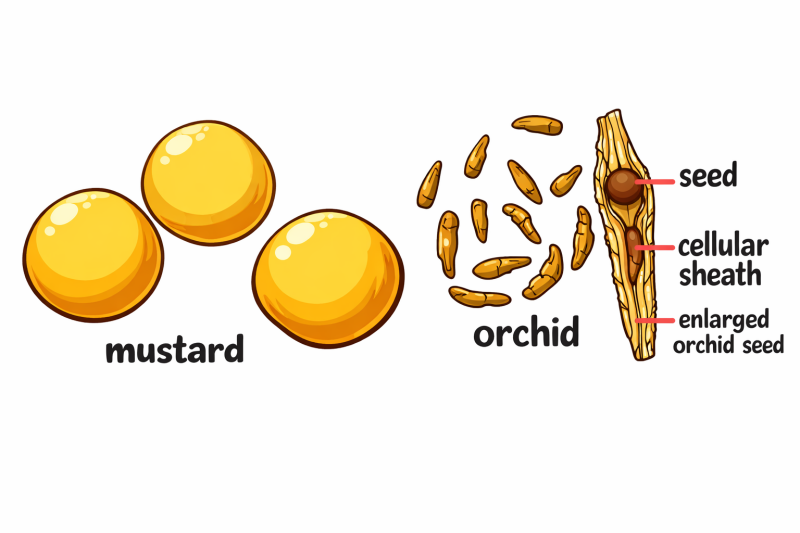
In this passage Jesus describes mustard seeds as the smallest of all other seeds. However, in this modern age it is now known that Orchid seeds, particularly epiphytic orchids, have the smallest seeds, as they are like dust. How could an all-knowing God not know that mustard seeds are not the smallest seeds? There are a few points to consider:
- Firstly, we must consider that Jesus is talking to people in the first century. They do not know much or anything about orchid seeds and their size. For Jesus to make a comparison that makes sense to this audience, He needs to use examples that they know.
- Secondly, the passage shows that Jesus was not referring to all the seeds in the world. He was referring to seeds that a Palestinian farmer sowed in his field. This is shown by the qualifying phrase "which a man took and sowed in his field" (v.
31). And it is a fact that the mustard seed was the smallest of all seeds which the Ist century Jewish farmer sowed in his field.
- Thirdly, in Jewish and Greco‑Roman literature, the mustard seed was a common proverb for something extremely small. Jesus is drawing on a well‑known idiom, not making a botanical taxonomy. For example, in the Mishnah (Niddah 5:2), the mustard seed is used proverbially to describe the smallest imaginable quantity. Furthermore, Rabbinic writings use “mustard seed” as a stock phrase for “the tiniest thing.” Jesus Himself uses it this way again in Matthew 17:20 to describe tiny faith.
- Jesus’ statement about the mustard seed is driven by the contrast essential to the parable rather than by a claim about absolute seed size. The power of the illustration lies in how something that begins extremely small, small enough to seem insignificant to a first‑century farmer, grows into something unexpectedly large and sheltering, mirroring the surprising expansion of God’s kingdom from obscure beginnings to global influence. Even if smaller seeds exist, they do not grow into anything tree‑like, so the mustard seed uniquely fits the rhetorical and theological purpose of the story.