Operation Praying Mantis
05/02/2026
Samuel Clifford
USS Samuel B. Roberts
The USS Samuel B. Roberts was an Oliver Hazard Perry-class frigate that belonged to the U.S. Navy. It was commissioned in 1986 and in January of 1988 it was deployed from its homeport in Newport Rhode Island to the Persian Gulf in order to aid in Operation Earnest Will which was a part of the Iran-Iraq War (1980-1988). On April 14, 1988 the USS Samuel B. Roberts attempted to rendezvous with the USS San Jose when a lookout spotted three black spheres in the water. As the ship attempted to back out of danger, it struck one. The explosion tore open the hull, snapped the keel, flooded engineering spaces, and ignited fires throughout the ship. With power failing and compartments rapidly filling with seawater, the crew faced the possibility of losing the ship entirely. Through intense damage‑control efforts such as improvised patches using mattresses and clothing, restarting generators by hand, and battling fires in extreme heat and smoke, the crew slowly stabilized the situation. After hours of work, they stopped the flooding, extinguished the last fires, and saved the ship from sinking. The Samuel B. Roberts was later transported for repairs and returned to service.
Ten sailors suffered injuries and four received severe burns. The United States matched the serial numbers of other mines in the area to other mines that the United States had found on an Iranian barge they had seized in September of the year prior. The USS Samuel B Roberts was determined to have hit a SADAF-02 mine. The United States, then under the presidency of Ronald Reagan, knew their target and four days later, on April 18, 1988, the US launched an attack on Iranian naval targets in retaliation to this mining incident.
Operation Praying Mantis
Under the directive of Ronald Reagan, multiple U.S. Navy surface action groups, supported by aircraft from the USS Enterprise and her escort USS Truxtun, moved into position to strike Iranian military targets tied to attacks on shipping. The first group, built around the destroyers USS Merrill and USS Lynde McCormick along with the amphibious transport dock USS Trenton and its embarked Marine contingent, was ordered to neutralize the Sassan oil platform, which Iran had been using as a command‑and‑control site. After issuing a warning and allowing time for evacuation, the group opened fire. The platform returned fire with anti‑aircraft guns, but U.S. ships quickly disabled the defenses. Marines then boarded the structure, gathered intelligence, and set demolition charges before destroying the facility.
A second U.S. group simultaneously targeted the Sirri oil platform. Although Navy SEALs had been assigned to seize it, the platform was already heavily damaged by naval gunfire and did not require an assault. Iran attempted to retaliate by deploying Boghammar speedboats to attack civilian and commercial vessels in the Gulf, damaging several ships. In response, A‑6E Intruder aircraft from the Enterprise located the speedboats and struck them with cluster munitions, sinking one and forcing the others to retreat. What began as a limited retaliation quickly escalated into a broader confrontation as Iranian naval forces moved to challenge the U.S. presence.
The fighting intensified when the Iranian fast‑attack craft Joshan confronted the cruiser USS Wainwright and its accompanying ships. After ignoring repeated warnings, Joshan fired a missile at the American vessels, prompting a decisive response. U.S. ships launched multiple Standard missiles that destroyed the craft’s superstructure, and gunfire ultimately sank the vessel. Iranian F‑4 Phantom jets attempted to intervene but withdrew after one was damaged by a U.S. missile. Soon after, the Iranian frigate Sahand engaged American aircraft and was struck by a barrage of Harpoon and laser‑guided Skipper missiles, causing fires that reached its ammunition magazines and sank the ship. Later that afternoon, another Iranian frigate, Sabalan, fired on U.S. aircraft and was immediately disabled by a precision‑guided bomb dropped into its exhaust stack, leaving it dead in the water. With Sabalan crippled and several major Iranian naval assets destroyed, U.S. forces shifted to a de‑escalatory posture to prevent further escalation. Iran chose not to continue the fight, and by the following day, hostilities had ceased.
By the end of Operation Praying Mantis, U.S. naval and Marine forces had dealt a decisive blow to Iran’s military presence in the Persian Gulf. American ships and aircraft destroyed Iranian intelligence and military facilities on two oil platforms and eliminated multiple naval threats, including at least three armed Boghammar speedboats, one fast‑attack missile boat, and the frigate Sahand. Another Iranian frigate, Sabalan, was heavily damaged after being struck by a precision‑guided bomb and had to be towed back to port for repairs. Although Sabalan eventually returned to service the following year, the losses Iran suffered during the operation significantly reduced its ability to threaten commercial shipping in the region.
The United States, however, sustained only one loss during the operation, a Marine Corps AH‑1T Sea Cobra helicopter attached to USS Trenton. The aircraft crashed after dark during a reconnaissance mission near Abu Musa Island, resulting in the deaths of both crew members. Navy divers later recovered their bodies and raised the wreckage, which showed no signs of combat damage.
The International Court of Justice ruled on November 6, 2003, that neither Iran nor the United States was entitled to reparations under the 1955 Treaty of Amity, since the treaty only protected trade and navigation between the two nations, activities already halted by the U.S. embargo. The court stated that U.S. attacks on Iranian oil platforms in 1987 and 1988 could not be justified as necessary for American security interests. However, it also concluded that Iran’s claim of a treaty violation could not be upheld, leaving both sides without legal compensation.
Conclusion:
Operation Praying Mantis ultimately marked a turning point in the final phase of the Iran‑Iraq War and demonstrated the extent of U.S. resolve in protecting its forces and commercial shipping in the Persian Gulf. What began as a direct response to the mining of the USS Samuel B. Roberts quickly evolved into a decisive display of American naval power, resulting in the destruction or disabling of several key Iranian naval assets and the neutralization of multiple military platforms used to threaten maritime traffic.
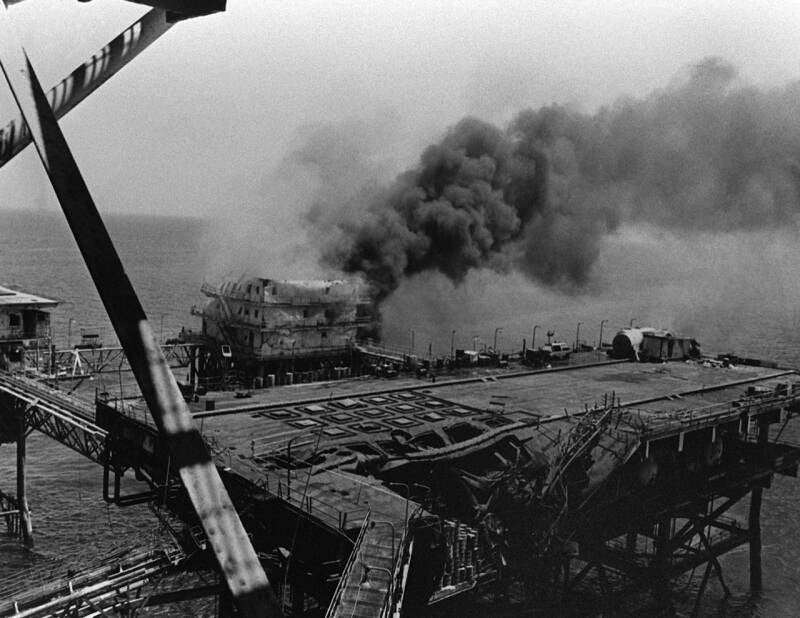
The main building of the Iranian Sassan oil platform burns after being hit by a BGM-71 Tube-launched, Optically-tracked, Wire-guided (TOW) missile fired from a Marine AH-1 Cobra helicopter.
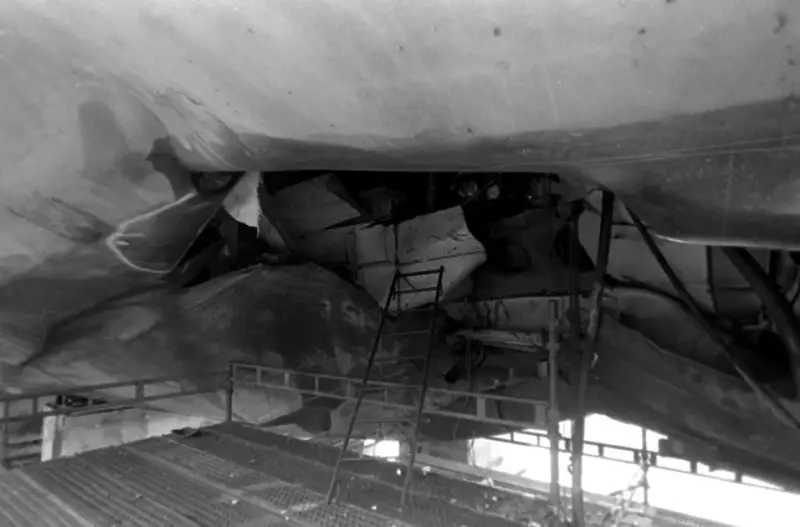
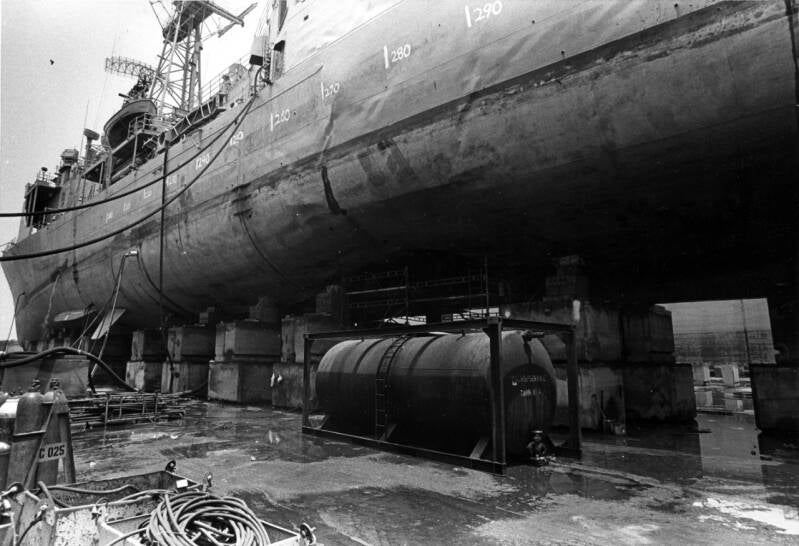
Two Images of damage to the hull of USS Samuel B. Roberts (FFG-58)
Sources:
“USS Samuel B. Roberts (FFG-58).” Wikipedia, Wikimedia Foundation, https://en.wikipedia.org/wiki/USS_Samuel_B.Roberts(FFG-58).
Peniston, Bradley. “The Day Frigate Samuel B. Roberts Was Mined.” USNI News, 22 May 2015, https://news.usni.org/2015/05/22/the-day-frigate-samuel-b-roberts-was-mined.
“Operation Praying Mantis.” Naval History and Heritage Command, U.S. Navy, https://www.history.navy.mil/browse-by-topic/wars-conflicts-and-operations/middle-east/praying-mantis.html.
Brands, Hal. “How Should the United States Respond to Iran After the Tower 22 Attack? Lessons from Operation Praying Mantis.” Modern War Institute at West Point, https://mwi.westpoint.edu/how-should-the-united-states-respond-to-iran-after-the-tower-22-attack-lessons-from-operation-praying-mantis/.
Zatarain, Lee Allen. “The One-Day War.” Naval History Magazine, Mar. 2013, https://www.usni.org/magazines/naval-history-magazine/2013/march/one-day-war.